
Starting something new when you are already dealing with a lot can feel like one more thing on a list that is already too long. You may have heard about Enhanced Care Management and wondered whether it is worth the effort. You may have agreed to try it but feel anxious about what to expect. Or you may have just been referred and have no idea what comes next.
That uncertainty is completely normal. And it is one of the reasons this article exists. Because knowing what to expect before you walk into something new makes it easier to show up. And showing up to that first appointment is genuinely one of the most important steps you can take.
Here is exactly what happens during your first ECM appointment, from start to finish, in plain language.

Before the Appointment: What to Know
First, a few things worth knowing before you even get to the appointment.
You do not need to bring anything specific
Your care manager will help you figure out what documentation is needed as part of the process. Not having paperwork ready is not a reason to cancel or postpone.
The appointment comes to you
Enhanced Care Management is a community-based program. That means your care manager meets you wherever you are. At home, in a shelter, at a community organization, in a hospital, or anywhere else that works for your situation. You do not have to figure out transportation to an office.
It is not a test
Nothing about the first appointment is designed to evaluate whether you deserve help or whether you qualify in a way that feels like an audition. It is a conversation. The goal is to understand your situation so that the right support can be coordinated around it.
There is no wrong way to show up
You do not have to have your thoughts organized. Likewise, you do not have to know what you need. You do not have to present yourself in any particular way. Come as you are.
The First Thing That Happens: Building Rapport
Before any formal assessment begins, a good care manager will spend time simply getting to know you. This is not small talk for the sake of it. It is the foundation of everything that follows.
Enhanced Care Management works because of the relationship between the care manager and the person they are supporting. That relationship does not start with paperwork. It starts with a human conversation. Your care manager will introduce themselves, explain what ECM is and how it works, and give you space to ask any questions you have before anything else happens.
At Solano Impact Care, this opening conversation tends to feel different from what many people expect. The care managers on the team have personally navigated homelessness, incarceration, substance use, mental health challenges, grief, and loss. They are not approaching your situation as an outsider trying to understand it. They understand it because they have lived versions of it themselves. That shared experience comes through in the very first conversation. And for many people, it is the first time they have felt genuinely understood by someone in a professional helping role.

The Comprehensive Assessment
After that initial connection, the care manager will begin what is called a comprehensive assessment. This is the formal part of the first appointment. But even this is designed to feel like a conversation, not an interrogation.
The assessment covers several areas of your life. Not just your medical needs but the full picture of what is going on and what you need.
Health and medical needs
Your care manager will ask about your current health conditions, any medications you are taking, your relationship with your primary care provider if you have one, and any upcoming medical appointments or procedures. They want to understand what is happening with your physical health so they can coordinate care effectively.
Mental health and behavioral health
This includes questions about how you have been feeling emotionally, whether you have experienced depression, anxiety, trauma, or other mental health challenges, and what support, if any, you have received in the past. As we covered in the article on Signs You May Need More Support With Your Mental Health, mental health needs are often interconnected with the other challenges people are navigating. Understanding the full picture matters.
Substance use
If substance use is part of your situation, the assessment will include questions about that. These questions are asked without judgment. The goal is not to evaluate or shame you. It is to understand whether substance use is a factor that needs to be addressed as part of your care plan.
Housing situation
Your care manager will ask about where you are currently living, whether that situation is stable, and whether housing is a challenge you are dealing with. For many people receiving ECM, housing instability is one of the most significant barriers to everything else. Understanding it from the beginning allows it to be addressed as a priority in the care plan.
Social supports
This includes questions about the people in your life. Do you have family or friends who provide support? Are there relationships that are a source of stress or conflict? Do you feel isolated or connected? The social dimension of your situation is directly relevant to the kind of support that will help most.
Practical barriers
Transportation, food access, income, employment, legal issues, childcare, and other practical factors that affect your daily life and your ability to engage with support. These are not afterthoughts. They are central to understanding what is actually getting in the way.
Your goals
Perhaps most importantly, the assessment includes a conversation about what you want. What does a better life look like to you? Also, what do you most want to change? What have you tried before that has or has not worked? Your goals are not an add-on to the care plan. They are the center of it.

How Long Does the First Appointment Take?
The first appointment is typically longer than subsequent ones. This is because the comprehensive assessment takes time to do properly. Depending on the complexity of your situation and how the conversation flows, the first appointment can last anywhere from one to two hours.
This might feel like a lot. But it is worth it. The time spent in this first conversation is what allows your care manager to build a care plan that actually fits your life rather than a generic template. Rushing through it produces a shallower picture that leads to less effective support.
If you need breaks during the conversation, ask for them. If certain questions feel too sensitive to address right away, it is okay to say so. The assessment can be completed across more than one conversation if that is what works best for you.
What Happens After the Assessment: The Care Plan
After the comprehensive assessment, your care manager uses what they have learned to develop an individualized care plan with you. Not for you. With you.
The care plan is a document that outlines:
- Your specific goals, both short-term and longer-term
- The services and supports that will help you reach those goals
- The steps involved in accessing each one
- Who is responsible for coordinating what
- How progress will be tracked over time
The care plan is not set in stone. It is a living document that gets updated as your situation changes and as you make progress toward your goals. If something is not working, it gets adjusted. If your priorities shift, the plan shifts with them.
What Coordination Looks Like After the First Appointment
Once the care plan is in place, your care manager begins the work of coordinating the support it outlines. This is where ECM becomes most visible in your daily life.
Depending on what your assessment identified, coordination might involve:
- Scheduling and following up on medical appointments
- Connecting you to mental health services and making sure that connection actually holds
- Coordinating housing navigation support through Solano Home Assist or other housing resources
- Connecting you to employment support through Match2Hire if employment is a goal
- Facilitating access to digital skills training through Solano EmpowerTech for justice-involved individuals who need it
- For women who need transitional housing or sober living support, connecting to Hazel’s Tranquility Place in Vallejo
Hazel’s Tranquility Place is a structured, supportive housing program in Solano County created to help people stabilize during vulnerable transitions. It is a transitional and sober living home in Vallejo founded by K. Patrice Williams, providing a safe haven and support services for women reentering the community from incarceration or recovering from substance use. Founded in 2019 while K. Patrice Williams was running for Solano County Supervisor, after she witnessed firsthand the gaps in housing and support for women and children in Solano County, Hazel’s Tranquility Place gives women a place where healing is structurally possible. Learn more at hazelstranquility.org.
Your care manager does not just make referrals and hand you a list of phone numbers. They follow through and check in to make sure connections happened. Also, they troubleshoot when something does not work. They stay involved in the ongoing coordination of your care rather than disappearing after the intake.
How Often Will You Hear From Your Care Manager?
After the first appointment, the frequency of contact depends on your situation and your needs. In the early stages of ECM, contact tends to be more frequent. As things stabilize and the care plan is running smoothly, it may become less frequent while remaining consistent.
Your care manager is available to you between scheduled contacts as well. If something comes up, if a crisis arises, if a referral falls through, or if you just have a question, you can reach out. That accessibility is one of the things that makes ECM different from a standard case management program.
What If the First Appointment Feels Hard?
For many people, the first ECM appointment brings up feelings that are unexpected. Talking about your full situation, including the parts you have been managing alone or have felt ashamed of, can be emotional. That is okay.
It is okay to cry. Also, it is okay to feel relief. It is okay to feel guarded at first and need time to trust the process. All of those responses are normal. And none of them will be met with judgment by the team at Solano Impact Care.
The care managers at Solano Impact Care have sat in rooms that felt very similar to the one you are sitting in. They know what it takes to be honest about a hard situation with someone you have just met. And they know how to hold that honesty with the care it deserves.
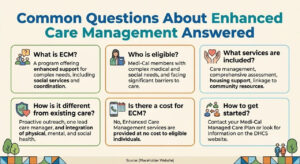
As we covered in the article on Common Questions About Enhanced Care Management Answered, ECM is designed specifically for people with complex needs who have often fallen through the gaps of other systems. The first appointment is not a hurdle to clear. It is the beginning of a relationship that is built specifically to support you.
How to Get Your First ECM Appointment
If you are a Medi-Cal member in Solano County and you think ECM might be right for you or someone you love, the starting point is a single conversation with Solano Impact Care.
You do not need a formal referral from a doctor. Likewise, you do not need to have your situation figured out. You just need to reach out and let the team assess whether ECM is the right fit for your circumstances.
You can get started by:
- Visiting solanoimpactcare.org/get-started
- Calling (707) 301-4051
- Emailing care@solanoimpactcare.org
The first appointment is the hardest one to make. Not because of anything that happens in it. But because deciding to ask for help takes courage. Once you make that decision and show up, everything else follows from there.