
When someone you love is struggling, your instinct is to do something. To fix it, to help, to be useful in some way that actually makes a difference. But when that person is enrolled in a care management program, it is not always clear what your role is supposed to be. Are you supposed to step back and let the professionals handle it? Are you supposed to be involved in every decision? What does helpful actually look like in this context?
These are questions families ask all the time. And they deserve clear, honest answers. Because family involvement in care management, done well, genuinely improves outcomes. Research consistently shows that people with engaged, informed family support navigate complex health and social challenges more successfully than those who are going it alone. But the kind of involvement that helps looks different from the kind that inadvertently creates more pressure or undermines the person’s autonomy.
This article is for families. It explains what care management is, what your role can look like within it, how to be genuinely helpful rather than accidentally harmful, and where to get support for yourself while you are supporting someone else.

What Care Management Is
Before exploring how families can participate, it helps to have a clear understanding of what care management is and what it is designed to do.
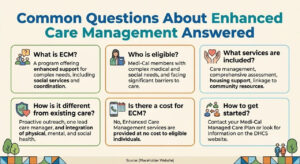
Enhanced Care Management, also called ECM, assigns a dedicated care manager to a Medi-Cal member with complex needs. That care manager coordinates across all of the person’s health, mental health, housing, and social service needs. They develop an individualized care plan with the person. Likewise, they follow through on referrals. They advocate within systems. And they maintain consistent contact over time rather than disappearing after an intake appointment.
As we covered in detail in the article on What Happens During Your First ECM Appointment?, the care plan is built around the goals and priorities of the person receiving care. Not the goals of their family, their doctor, or their care manager. The person themselves is at the center.
That distinction matters because it shapes what family participation looks like. Your role is not to direct the care. It is to support the person who is receiving it.
Why Family Involvement Matters
Family members often have context that care managers and other professionals do not have. You have known this person for years. You understand their history, their patterns, their triggers, and what has and has not worked in the past. That context is genuinely valuable when it is offered in the right way.
Beyond the information you carry, your emotional presence matters. People navigating complex health and life challenges who have family members who are engaged, encouraging, and consistent tend to do better than those who feel alone in the process. Not because family members solve the problems but because knowing someone who loves you is paying attention and rooting for you creates a kind of resilience that professional support alone cannot fully replicate.
Family involvement is also important in a practical sense. Care management often involves appointments, paperwork, phone calls, and coordination tasks that can be difficult for someone dealing with mental health challenges, cognitive difficulties, or the overwhelming weight of multiple crises at once. Having a family member who can help with logistics, without taking over, reduces the practical burden significantly.
Getting Permission First
This is the starting point for everything else. Before involving yourself in someone’s care management, you need their permission.
Care management is built around the autonomy and self-determination of the person receiving care. Their health information is protected by law. Their care plan is their own. A care manager cannot share information about a client with a family member without the client’s explicit consent.
This is not bureaucratic obstruction. It is respect for the dignity and privacy of the person being served. And it is especially important for people whose histories include experiences of having their autonomy overridden by others, whether in institutions, family systems, or relationships.
The right way to begin family participation is to have a conversation with your loved one. Ask whether they want you involved and in what ways. Ask whether they are comfortable with you having contact with their care manager and what they want you to know or not know. If they say yes to some form of involvement, that conversation, and any consent forms it leads to, is the foundation of everything else.
If they say no or not yet, respect that. It may change over time. And respecting their boundary now is itself a form of support.
Call (707) 301-4051 or email care@solanoimpactcare.org. You can also visit solanoimpactcare.org/get-started to learn more about what support is available.

Photo by Priscilla Du Preez 🇨🇦 on Unsplash
Ways Families Can Be Genuinely Helpful
Once permission is established, there are several specific ways that family members can participate in care management in ways that actually help.
Attending appointments when invited
If your loved one wants you present at a care management appointment or a medical appointment, being there provides both practical and emotional support. You can help remember information, ask questions that your loved one may not think to ask in the moment, and provide context from your own observation of how things have been going. But the emphasis is on when invited. Showing up to appointments uninvited, even with good intentions, can feel invasive and undermine the trust your loved one is building with their care manager.
Helping with logistics
Appointments need to be kept. Paperwork needs to be completed. Phone calls need to be made. For someone managing mental health challenges or the cognitive load of a complex life situation, these logistics can be genuinely overwhelming. Offering to help with transportation, reminders, or paperwork without taking over entirely is a practical contribution that reduces burden without removing autonomy.
Being a consistent, calm presence
One of the most important things a family member can offer is simply being reliably there. Not with pressure or anxiety or constant checking in, but with a steady presence that communicates that you are not going anywhere. For people who have experienced a lot of abandonment or instability, that consistency is itself healing.
Sharing observations with permission
If you have noticed something that seems important, a change in behavior, a new challenge, a sign that something is going better or worse, and your loved one has given you permission to communicate with their care manager, sharing those observations can be genuinely valuable. Care managers appreciate having additional context from people who know the client well. But this should always happen with your loved one’s knowledge and consent, not as a back-channel report.
Celebrating progress
Recovery and rebuilding are long processes with small milestones along the way. Acknowledging those milestones, whether that is a week of sobriety, a kept appointment, a successful conversation with a landlord, or simply getting through a hard day, matters more than most families realize. Progress that is noticed and celebrated tends to build on itself.
Taking care of yourself
This is not a throwaway point. When families are exhausted, anxious, and depleted, the support they offer tends to become less helpful and more pressuring. As we covered in the article on How to Support a Loved One in Recovery Without Burning Out, sustainable support requires that you have support of your own. A family member who is getting their own help is a better support person than one who is running on empty and operating from fear.
What Family Members Should Avoid
Just as there are ways to be genuinely helpful, there are ways that well-intentioned family involvement can inadvertently undermine the care management process.
Taking over the care plan
The care plan belongs to your loved one. Family members who try to redirect the goals of care management toward what they think their loved one needs, rather than what the person themselves has said they need, undermine the autonomy that is central to the program’s effectiveness. Your perspective matters. But it does not override your loved one’s.
Using care management appointments as an opportunity to raise grievances
If you are invited to a care management appointment, that appointment is not the place to address unresolved family conflict or to communicate your frustrations with your loved one’s choices. It is the place to support your loved one’s engagement with their care. Family conflict is important and deserves its own space, separate from care management.
Creating pressure around timelines
Recovery and stability do not happen on anyone else’s schedule. Family members who communicate, explicitly or implicitly, that they expect faster progress than is realistic create pressure that tends to produce shame and withdrawal rather than motivation. Trust the process and resist the urge to set external timelines.
Sharing private information without consent
If your loved one has shared information with you about their care, their goals, or their challenges, that information is not yours to share with other family members, employers, or anyone else without explicit permission. Breaching that trust damages the relationship and can undermine your loved one’s willingness to remain open with you.
Making participation conditional
Offering support only if your loved one meets certain conditions, stays sober, keeps appointments, follows your advice, creates a dynamic that is more controlling than supportive. Real support does not come with conditions attached.
When the Person You Love Is Resistant to Care Management
Sometimes the hardest situation families face is not how to participate in care management but how to support someone who does not yet want it.
If your loved one is resistant to engaging with care management or any other form of support, there is no script that will override that resistance. What you can do is stay connected, remain available, avoid making your support conditional on their acceptance of help, and continue gently making the case for why support is available and what it might offer.
It is also worth examining what the resistance is about. Sometimes resistance to care management reflects a history of negative experiences with systems and institutions. Also, sometimes it reflects shame about the situation. Sometimes it reflects a genuine lack of trust that things can be different. Understanding the source of the resistance helps family members respond in ways that address it rather than intensify it.
For people in Solano County who are resistant to formal care management, peer support, offered by someone with lived experience rather than a professional role, is sometimes the bridge that opens the door. The team at Solano Impact Care includes people who have navigated that exact resistance themselves and who know how to meet people where they are rather than where programs wish they were.
Supporting Women and Mothers Through the Care Management Process
For families supporting women who are navigating care management alongside recovery, reentry, or family reunification, the complexity is significant. Women in these situations are often managing not just their own needs but the needs of their children, the expectations of the legal system, and the emotional weight of family separation.
Family support that acknowledges that complexity, that does not minimize it or rush past it, is genuinely valuable. Being present for a mother who is working toward reunification with her children means understanding how much is at stake and showing up for the long haul of what that process requires.
For women in Solano County who need residential support alongside care management, Hazel’s Tranquility Place in Vallejo provides transitional housing and sober living in a structured, compassionate environment. It is a transitional and sober living home founded by K. Patrice Williams, providing a safe haven and support services for women reentering the community from incarceration or recovering from substance use. Founded in 2019 while K. Patrice Williams was running for Solano County Supervisor, after she witnessed firsthand the gaps in housing and support for women and children in Solano County, Hazel’s Tranquility Place was built directly in response to what she saw. Families supporting women clients can learn more at hazelstranquility.org.
You Are Part of This
Family participation in care management is not a formality. Done well, it is one of the most meaningful contributions to a loved one’s recovery and stability that you can make.
It requires patience and humility about the limits of your role. It requires getting your own support so that you can show up consistently over the long haul. And it requires trusting that the person you love, supported by a care management team that genuinely understands their situation, is capable of finding their way through.
At Solano Impact Care, families are considered part of the support ecosystem around the people they serve. The team understands, from their own lived experience, what it means to have family members who stayed present through the hardest chapters. And they know how much that presence matters.
Call (707) 301-4051 or email care@solanoimpactcare.org. You can also visit solanoimpactcare.org/get-started to learn more about what support is available.