
Managing one health condition is hard enough. Managing several at once is a different challenge entirely. Different doctors, medications, appointments and instructions that sometimes seem to contradict each other. And the constant pressure of keeping track of all of it while also managing the rest of your life.
Most people in this situation do not have a system. They carry information in their heads, in scattered papers, or in text messages they cannot find when they need them. Then something falls through the cracks. A medication interaction goes unnoticed. An appointment gets missed. A specialist does not know what another provider already tried.
Good organization does not fix every problem. But it reduces the risk of those gaps significantly. And it puts you in a stronger position every time you interact with any provider in your care network.
This article walks through practical, accessible ways to organize your medical information when you are managing multiple health needs.
Start With One Central Document
The most important first step is creating one place where your essential medical information lives. Not scattered across multiple apps, papers, and memories. One document. One location.
This does not need to be complicated. A simple notebook works. A notes app on your phone works. A printed template works. What matters is that it exists and that you actually use it.
Your central document should include:
- Your full name and date of birth
- Your Medi-Cal or insurance ID number
- The name and contact information for each of your providers
- Your current medications including dosage and frequency
- Your known allergies including medication allergies
- Your major diagnoses in plain language
- Your emergency contacts
- Any upcoming appointments with dates and locations
Keep this document updated. Every time a medication changes or a new provider is added, update it the same day. An outdated document creates its own risks.
If you or someone you know needs bed placement at Hazel’s Tranquility Place, contact Solano Impact Care today.
Keep a Medication List Separate and Specific
Medications deserve their own dedicated list. Medication errors are one of the most common and preventable sources of healthcare harm. A clear, current medication list reduces that risk significantly.
Your medication list should include:
- The name of each medication, both brand and generic if you know both
- The dose you take
- How often you take it and at what time of day
- What condition it is prescribed for
- Which doctor prescribed it
- The pharmacy where it is filled
Bring this list to every appointment. Every provider you see should know every medication you are taking. This is especially important when you are seeing multiple providers who may not communicate with each other automatically.
Additionally, update this list immediately when anything changes. Do not rely on memory. Medication changes are one of the most common places where important details get lost.
Track Your Appointments in One Place
Missing appointments is one of the most common ways that care for complex health needs breaks down. Tracking all appointments in one place prevents that.
Use a single calendar. This can be a paper calendar, the calendar app on your phone, or a simple notebook. What matters is that every appointment goes in the same place the moment it is scheduled.
For each appointment, record:
- The date and time
- The provider’s name and specialty
- The location and address
- The phone number to call if you need to reschedule
- What the appointment is for
Set a reminder at least one day before each appointment. Transportation barriers are one of the most common reasons appointments are missed. Plan how you are getting there before the day arrives, not the morning of.
If you consistently struggle to keep appointments because of transportation, mental health challenges, or other barriers, that is important information. It signals that you may need additional support. Solano Impact Care’s care managers actively help clients manage appointments as part of Enhanced Care Management. They follow through rather than leaving it entirely to you.
Reach out at (707) 301-4051 or email care@solanoimpactcare.org to get connected.

Photo by Markus Winkler on Unsplash
Create a Simple Health History Summary
Every time you see a new provider, they ask the same questions. What conditions do you have? What medications are you on? Have you had any surgeries? What allergies do you have?
Answering these questions from memory under pressure is stressful and often inaccurate. A simple health history summary solves this problem. Write it once and bring it to every new appointment.
Your health history summary should include:
- Your current diagnoses
- Past diagnoses that are relevant to your current care
- Surgeries and hospitalizations with approximate dates
- Significant injuries or medical events
- Family health history if relevant, for example a parent with heart disease or diabetes
- Current medications
- Allergies
Keep this summary to one page. Its purpose is to give a new provider a quick, accurate picture of your health background. Brevity makes it more likely to actually be read.
Keep Your Test Results and Records in One Place
Test results, lab reports, imaging reports, and discharge summaries are valuable. They tell the story of your health over time. And they are frequently needed by providers who were not present when those tests were done.
Start a simple system for keeping these records. This can be:
- A physical folder or binder organized by date or by provider
- A folder on your phone or computer where you photograph or scan documents
- An envelope kept with your other important documents
When you receive test results, ask your provider to explain what they mean in plain language. Write down the key points or ask for a printed copy. Do not assume that another provider will have access to those results automatically. Many systems do not share records across organizations without an explicit request.
Know Who to Call for What
When you are managing multiple health needs, knowing which provider handles which situation saves time and reduces panic in difficult moments.
Make a simple contact sheet that answers these questions:
- Who is your primary care provider and what is their phone number?
- Who do you call for mental health concerns?
- Who do you call if your medication needs to be refilled or changed?
- Who do you call if you have a question about a specific condition?
- Who do you call after hours if something urgent comes up?
- What is the number for your nearest emergency room?
- What is the number for the 988 Suicide and Crisis Lifeline if you or someone you know is in mental health crisis?
Keep this contact sheet with your central medical document. Review it periodically to make sure the information is still current.
Ask for Help With Coordination
Organizing medical information is one part of managing multiple health needs. The other part is making sure that the providers involved in your care are actually talking to each other and working from the same picture.
That is genuinely difficult to manage on your own. Providers operate in different systems. They do not always receive records from each other automatically. And the responsibility for connecting the dots often falls on the patient.
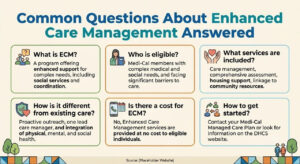
This is exactly the gap that Enhanced Care Management addresses. A care manager at Solano Impact Care holds the full picture of your health and social needs. They coordinate between your providers. Likewise, they make sure that a medication prescribed by one specialist does not conflict with something prescribed by another. They ensure that your mental health provider knows about relevant changes in your physical health. And they follow through on every referral rather than leaving you to navigate the connection alone.
As we covered in the article on Why Having One Care Team Can Make Getting Help Easier, having one coordinated team reduces the burden of managing multiple health needs significantly. You focus on getting better. Your care team focuses on making sure the systems around you are working together toward that goal.
For Women Who Need Residential Support
Managing multiple health needs is even harder without stable housing. When you do not have a safe, consistent place to live, keeping track of medications, attending appointments, and maintaining any kind of health routine becomes nearly impossible.
For women in Solano County who need a stable, structured residential environment alongside health and recovery support, Hazel’s Tranquility Place in Vallejo provides exactly that. It is a transitional and sober living home founded by K. Patrice Williams, providing a safe haven and support services for women reentering the community from incarceration or recovering from substance use.
Founded in 2019 while K. Patrice Williams was running for Solano County Supervisor, after she witnessed firsthand the gaps in housing and support for women and children in Solano County, Hazel’s Tranquility Place was built directly in response to what she saw.
If you or someone you know needs bed placement at Hazel’s Tranquility Place, contact Solano Impact Care today.
Call (707) 301-4051 or email care@solanoimpactcare.org. You can also visit solanoimpactcare.org/get-started to begin the process.
Use Technology Simply
Technology can help with organization. But it does not have to be complicated to be effective. Simple tools work better than complex ones that require significant time and learning.
A few practical technology tools worth considering:
- Your phone’s notes app for a quick medication list or appointment reminder
- Your phone’s calendar for appointment tracking with reminders
- A photos folder for photographing and storing important medical documents
- A simple email to yourself summarizing important health information so it is searchable later
The goal is not a perfect digital system. The goal is having information available when you need it. Whatever tool you will actually use consistently is the right tool.
Getting Connected to Coordinated Care in Solano County
Organizing your medical information is an important step. But it is most effective when it is part of a broader system of coordinated care that ensures your providers are working together and your needs are being addressed as a whole.
For eligible Medi-Cal members in Solano County, Solano Impact Care provides Enhanced Care Management and Community Supports that coordinate across health, mental health, housing, and social needs. Their care managers help clients manage the practical complexity of multiple health needs alongside the life challenges that make that complexity harder to navigate.
Their team brings lived experience of navigating health systems, housing instability, recovery, and reentry to every interaction. They understand this complexity not just professionally but personally.
Call (707) 301-4051, email care@solanoimpactcare.org, or visit solanoimpactcare.org/get-started to get started.