For a long time, healthcare meant what happened inside a doctor’s office or a hospital. You got sick, you went in, you received treatment, you went home. The assumption built into that model was that health was primarily a medical matter, managed by medical professionals in medical settings.
That assumption has been crumbling for years, and the evidence against it is now impossible to ignore. What determines whether a person is healthy has far more to do with where they sleep, whether they have enough food, how stable their income is, whether they feel safe, and whether they have people around them who care, than it does with any single clinical intervention. These are called social determinants of health, and they account for a significant portion of health outcomes across every population studied.
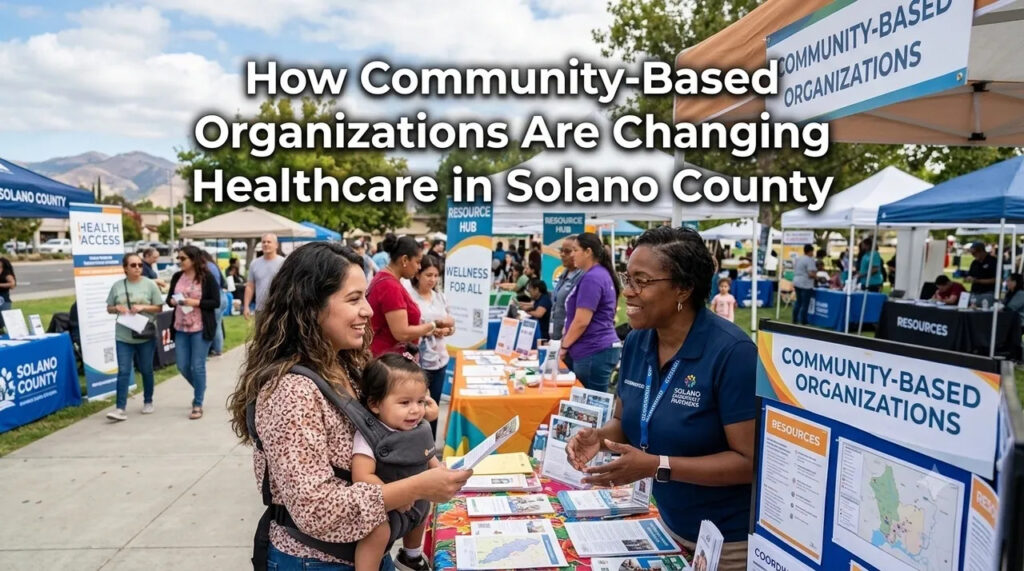
Community-based organizations have understood this for a long time. Long before it became policy language, organizations rooted in the communities they serve were addressing the real conditions that drive poor health outcomes. They were helping people find housing, navigating benefit systems, providing peer support, and building the kind of trust that clinical institutions have historically struggled to create with underserved communities.
Now the healthcare system is catching up. And in Solano County, organizations like Solano Impact Care are at the center of that shift.
What Community-Based Organizations Actually Do
A community-based organization, often called a CBO, is an organization rooted in and accountable to a specific community. Unlike large hospital systems or government agencies, CBOs are typically smaller, more flexible, and more directly embedded in the daily lives of the people they serve.
In the healthcare context, CBOs do the work that clinical systems are not designed to do. They reach people who do not trust institutions. They navigate bureaucratic systems on behalf of people who lack the time, knowledge, or energy to navigate them alone. They provide services in community settings, homes, shelters, and streets, rather than requiring people to come to them. And they build the kind of long-term, trusting relationships that are essential for people with complex, overlapping needs.
The range of what CBOs provide includes:
- Care coordination and navigation across health and social services
- Housing support and stability services
- Peer support from people with lived experience
- Employment readiness and workforce development
- Mental health outreach and connection to treatment
- Substance use recovery support
- Reentry services for justice-involved individuals
- Food access, transportation assistance, and basic needs support
None of these services are glamorous. None of them make headlines. But collectively they address the conditions that determine whether a person stays healthy, stays housed, stays employed, and stays out of the emergency room.
Why CalAIM Changed Everything for CBOs in California
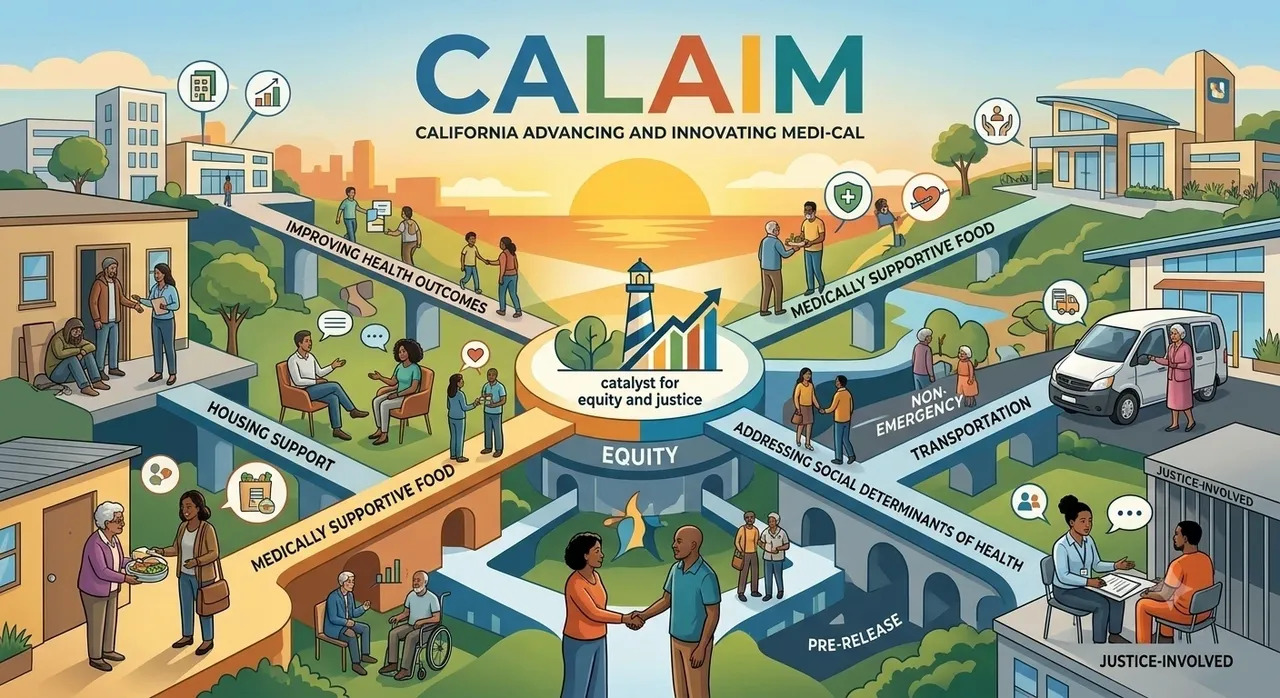
The formal recognition of community-based organizations as healthcare partners in California accelerated significantly with the launch of CalAIM in 2022. As we covered in detail in the article on How CalAIM Is Changing Healthcare for Low-Income Californians, this major Medi-Cal reform created two programs that specifically open the door for CBOs to be funded as part of the healthcare system.
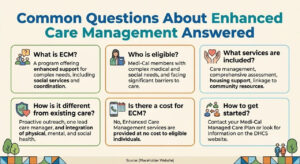
Enhanced Care Management provides high-touch, coordinated care for Medi-Cal members with the most complex needs, delivered by organizations with deep community roots and the ability to meet people wherever they are.
Community Supports provides a set of services that go beyond traditional medical coverage to address housing, recovery, nutrition, and social stability, funded through Medi-Cal managed care plans and often delivered by CBOs.
This shift is significant for two reasons. First, it provides sustainable funding for work that CBOs have been doing for years without adequate resources. Second, it formally recognizes that health outcomes cannot be improved by medical interventions alone, and that the organizations best positioned to address the underlying conditions of poor health are often not hospitals or clinics but community-based organizations with genuine roots in the communities they serve.
Solano Impact Care is one of the organizations in Solano County delivering both Enhanced Care Management and Community Supports through CalAIM. And what they bring to that work goes beyond program compliance.
Deep Local Knowledge as a Healthcare Asset
One of the most undervalued assets a community-based organization can have is genuine local knowledge. Not the kind that comes from reading county health assessments and demographic reports, but the kind that comes from being from a place, knowing its streets, its history, its people, its gaps, and its strengths from the inside.
The team at Solano Impact Care was born and raised in Solano County. They know Vallejo, Fairfield, Vacaville, Dixon, Suisun City, and Rio Vista not as service delivery zones mapped on a spreadsheet but as home. That deep local connection shapes everything about how they provide care.
It means they know which resources actually exist versus which ones are listed on a referral sheet but are not currently accepting clients. It means they understand the specific cultural dynamics of different neighborhoods and can engage with people in ways that reflect that understanding. It means they can anticipate the barriers a particular person is likely to hit before those barriers become crises, because they have seen those same barriers from both sides, as people who lived them and as people who now help others navigate them.
This nuanced, localized knowledge is not something that can be imported from outside the community. It is built over years of being present, being trusted, and being part of the fabric of a place. It is one of the primary reasons community-based organizations produce outcomes that larger, more distant institutions cannot replicate, even with greater resources.
A Network Built Around the Whole Person
One of the things that makes Solano Impact Care distinctly effective as a community-based healthcare partner is that it does not operate in isolation. It is connected to a broader network of organizations, each addressing a different dimension of what people in Solano County actually need to be healthy and stable.
Hazel’s Tranquility Place is a women and children’s transitional home in Vallejo that provides transitional housing, sober living, and aftercare support for vulnerable women and children. Founded in 2019 by K. Patrice Williams after she witnessed firsthand the serious gaps in housing and programming for women and children in Solano County during her campaign for Solano County Supervisor, Hazel’s Tranquility Place was built on the understanding that women in crisis need more than a referral list. They need a safe place to land, a structured community, and support that addresses recovery, housing, and family stability all at once. For Solano Impact Care clients who are women navigating homelessness, recovery, or family reunification, the connection to Hazel’s Tranquility Place provides exactly the residential foundation that healthcare and recovery cannot be built without. Learn more at hazelstranquility.org.
BrandGOV is dedicated to delivering impactful, community-focused solutions through interactive outreach, education, and economic development capacity building. For Solano Impact Care clients who are ready to engage more deeply with their community or who need support navigating civic and economic systems, BrandGOV addresses the structural and educational dimensions of stability that healthcare alone does not touch.
Match2Hire is a registered nonprofit that bridges the gap between job seekers and employers, with a focus on enhancing employment opportunities for individuals from all walks of life, including people with barriers to traditional employment. For clients in recovery, returning from incarceration, or rebuilding after homelessness, employment is not just a financial goal. It is a health intervention. Stable income reduces stress, provides structure, creates purpose, and removes one of the most significant risk factors for relapse and mental health deterioration. Match2Hire addresses that dimension in a way that care management alone cannot.
Together these organizations create what healthcare systems have always needed but rarely achieved: a coordinated network that addresses the whole person, not just the diagnosis.
Lived Experience as a Healthcare Strategy
There is a growing body of research confirming what community advocates have known for a long time: that peer support, provided by people with lived experience of the conditions being addressed, produces measurably better outcomes than professional support alone, particularly for populations that have historically distrusted institutions.
Solano Impact Care builds this into everything they do. The team has personally faced homelessness, incarceration, mental health crises, substance use, grief, and loss. They have navigated the systems they now help their clients access. They understand not just the clinical picture of what their clients are dealing with but the lived texture of it, the shame, the exhaustion, the moments of wanting to give up, and what it takes to keep going.
That shared experience is not incidental to the healthcare work. It is central to it. It is what creates trust quickly, reduces the stigma that prevents people from seeking help, and allows honest conversations to happen that might take months to reach in a more traditional clinical relationship.
What This Means for Solano County’s Health Ecosystem
The shift toward community-based organizations as formal healthcare partners is not just good for individual clients. It is good for the entire Solano County health ecosystem.
When people with complex needs receive coordinated, relationship-centered support from organizations they trust, several things happen at a population level:
- Emergency room visits decrease as people get preventive support before crises escalate
- Hospitalizations are shorter and readmission rates drop when post-discharge support is coordinated
- Mental health crises are addressed earlier and more effectively
- Housing instability, one of the most significant drivers of poor health outcomes, is addressed rather than ignored
- The people most likely to cycle through expensive systems repeatedly get the consistent support that breaks that cycle
These are not speculative outcomes. They are what the research on community-based care consistently shows, and they are what CalAIM was designed to produce at scale across California.
For Solano County specifically, having organizations like Solano Impact Care embedded in the community, connected to a network of partners, and staffed by people with deep local roots and lived experience, represents an investment in health infrastructure that pays dividends at every level, from the individual receiving care to the healthcare system bearing the cost of unmet need.
Getting Connected
If you are a Medi-Cal member in Solano County with complex health and social needs, or if you are a healthcare provider, social worker, or community partner looking to refer someone to coordinated community-based support, Solano Impact Care is here.
Their team provides Enhanced Care Management and Community Supports for eligible Medi-Cal members, with connections to housing through Hazel’s Tranquility Place, employment support through Match2Hire, and community capacity building through BrandGOV.
To get connected or make a referral, call (707) 301-4051 or email care@solanoimpactcare.org.
The future of healthcare in Solano County is not happening only in hospitals and clinics. It is happening in communities, in homes, in shelters, and in the relationships between people who have been through something and the people who are going through it now. That is what community-based healthcare looks like. And it is already changing lives in Solano County.