There is a particular kind of paralysis that comes when you have lost everything. The kind where you wake up and the life you had, or the life you thought you were going to have, is simply gone.
Maybe you are sitting in a cell with a release date on the calendar and no real plan for what comes after. Maybe you are in a shelter, sleeping in a car, or on someone’s couch trying to figure out how to get somewhere stable. Maybe you just finished a treatment program and you are standing at the edge of a life that needs to be built almost from scratch.
In moments like those, the advice to set goals can feel almost insulting. But the people who find their way through these situations almost always have one thing in common. They picked one thing and did it. Then they picked the next thing.
That is what goal setting actually looks like when you have lost everything. Not a vision board. A next step. This guide is built for people starting from very little who need a practical, honest framework for moving forward.
Why Goals Feel Impossible When You Are in Crisis
Before getting into the how, it is worth acknowledging why goal setting feels so difficult when you are in survival mode. Because if you have tried to think about the future and felt your mind go blank or your chest tighten, that is not a personal failure. It is a predictable response to what your nervous system is experiencing.
When a person is in a state of chronic stress or trauma, the brain’s capacity for long-term planning is genuinely reduced. The part of the brain responsible for planning, decision-making, and imagining the future is the prefrontal cortex. When the body is in survival mode, resources are redirected away from that area and toward the parts of the brain managing immediate threat response. In simple terms: your brain is doing exactly what it is supposed to do to keep you alive right now, and long-term planning is not part of that job.
This is not an excuse to not try. It is an explanation for why you need to start smaller than you might think. And it is a reason to extend yourself some compassion for how hard this actually is.
Start With Stabilization, Not Transformation
One of the most common mistakes people make when trying to rebuild after significant loss is trying to do too much too soon. The motivation to turn everything around quickly is understandable, especially after incarceration or an extended period of homelessness or active addiction. There is a lot of ground to cover and it feels urgent to cover it all at once.
But sustainable change does not work that way. It works in layers. And the first layer is always stabilization.
Before you can build anything meaningful, you need a foundation stable enough to build on. That means:
- Safe shelter: Whether that is transitional housing, a sober living program, a shelter placement, or staying with a trusted family member, having a consistent place to sleep is the first building block of everything else.
- Basic physical health: Food, sleep, and any immediate medical needs addressed. A body in crisis cannot sustain the effort that rebuilding requires.
- Safety from immediate threats: If you are in a situation involving domestic violence, active substance use, or an unsafe environment, addressing that comes before anything else.
- Connection to at least one supportive person or organization: Isolation is one of the most significant barriers to recovery and rebuilding. You need at least one person or resource that is genuinely in your corner.
If you do not yet have these things, finding them is your goal right now. Full stop. That is not settling for less. That is building the foundation without which everything else collapses.
The One-Thing Method: How to Set Goals When Everything Feels Overwhelming
Once basic stabilization is in place, the question becomes how to start moving forward without being paralyzed by the size of the mountain in front of you.
The answer is the one-thing method. It is exactly what it sounds like.
You identify one thing. One specific, achievable thing you can do today or this week that moves you in a direction you want to go. Not ten things. Not a list of everything that needs to happen to rebuild your life. One thing.
Here is why this works. When the gap between where you are and where you want to be is enormous, the brain tends to either fixate on the whole distance and shut down, or it jumps to the end goal and skips over the practical steps needed to get there. Neither produces action. The one-thing method bypasses both of those traps by giving you something concrete and completable.
Some examples of what one thing might look like at different stages:
If you are recently released from incarceration:
- Getting a state ID or replacing lost documents
- Attending one reentry resource meeting or appointment
- Calling one employment program to ask what the process looks like
- Connecting with a care manager or case worker who can help you map out next steps
If you are experiencing homelessness:
- Calling Solano impact Care to find out what shelter or transitional housing options exist in your area
- Making one appointment with a housing navigation service
- Connecting with a peer support worker who can walk through options with you
- Identifying one organization in your community that serves people in your situation
If you are in early recovery:
- Attending one meeting
- Making one call to a sponsor or supportive person
- Completing one task from your care plan
- Researching one job training or employment program
The one thing does not have to be dramatic. It just has to be real and it has to be done.
How to Set Goals That Actually Work
Once you are moving, the next step is learning how to set goals in a way that builds momentum rather than setting you up for disappointment. Here is a framework that works for people rebuilding from very little.
Make it specific
Vague goals produce vague results. “Get my life together” is not a goal. “Apply for a state ID this week” is a goal. The more specific you are, the more clearly you can see whether you did it or not.
Make it realistic for where you actually are
Not where you want to be, not where you think you should be, but where you actually are right now. Setting goals that require resources or stability you do not yet have sets you up to fail, which erodes the confidence you need to keep going. Start where you are.
Break big goals into small steps
Getting housed is a big goal. But it is made up of smaller steps: finding out what programs exist, making a call, filling out an application, attending a meeting, getting on a waitlist. Each of those steps is its own goal. Completing each one is a real win.
Write it down
There is something about putting a goal in writing that makes it more real. It also gives you something to look back on and see how far you have come, which matters more than most people expect when you are in the middle of a long process.
Tell someone
Accountability is one of the most practical tools for goal completion. Telling a care manager, a peer support worker, a sponsor, or a trusted person what you are working toward creates a form of external accountability that supplements your own internal motivation on the days when that motivation is running low.
Celebrate completion, not perfection
In early rebuilding, the goal is movement, not mastery. Completing a step imperfectly is still completing a step. Give yourself genuine credit for what you accomplish rather than fixating entirely on what is still left to do.
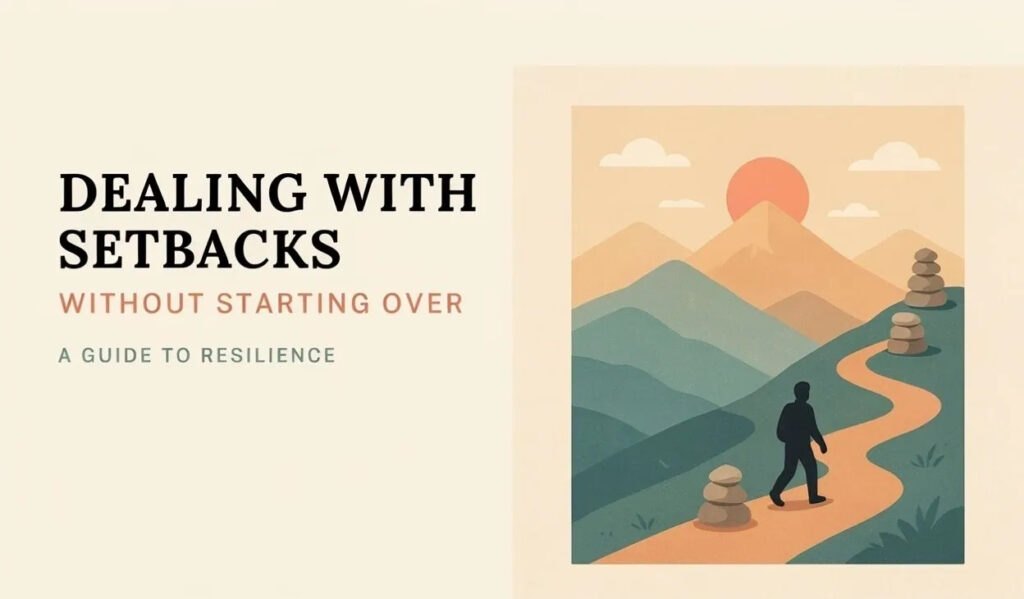
Dealing With Setbacks Without Starting Over
Setbacks are not the exception in the rebuilding process. They are part of it. A missed appointment, a relapse, a lost job, an eviction, a relationship that falls apart, these things happen to people who are genuinely trying, and they can feel catastrophic when your foundation is still fragile.
The difference between people who ultimately rebuild and those who do not is rarely the absence of setbacks. It is what they do when a setback happens.
A few things worth remembering when a setback hits:
- A setback is not evidence that rebuilding is impossible for you. It is evidence that rebuilding is hard, which you already knew.
- You do not start over from zero. You start over from where you are, which is further along than where you started even if it does not feel that way right now.
- The most important thing after a setback is how quickly you return to support. Not how quickly you recover emotionally, but how quickly you reach out to the people and resources that help you move forward.
- Self-blame and shame slow the recovery from setbacks significantly. The faster you can move from “I failed” to “that did not work, what is the next step,” the faster you get moving again.
As we discussed in the article on What to Do When Someone You Love Relapses, one of the most important things to understand about setbacks in recovery is that they do not erase progress. The same is true in the broader rebuilding process. Every step forward stays. A setback means you are starting from a step back, not from the beginning.
How Solano Impact Care Walks Alongside You in This Process
Solano Impact Care was built by people who have been exactly where many of their clients are. The team has personally navigated homelessness, incarceration, mental health crises, substance use, and the process of rebuilding from very little. They are not guiding people through a process they read about in a textbook. They are sharing a road they have already walked.
That matters enormously in the context of goal setting after significant loss. Because one of the most powerful things a person in crisis needs is not just practical information, though that matters too. It is the experience of being seen by someone who genuinely understands their situation, believes they can move forward, and knows from personal experience what the steps actually look like.
Solano Impact Care’s approach is built around empowering personal transformation across physical health, mental health, and social support. Their care managers help clients identify where they are, figure out what is possible next, connect to the resources that make those steps possible, and stay supported through the process of taking them.
They also address something most programs overlook: the systemic barriers that make rebuilding so much harder than it needs to be. A team with lived experience in navigating those barriers knows how to help people move through them, around them, or in spite of them, in ways that a provider without that background simply cannot.
As we covered in the article on What Is a Resilience-Building Program and Who Is It For?, the most effective support is not just what is delivered but how it is delivered. The relationship between the person seeking help and the person providing it matters deeply. Solano Impact Care builds that relationship on a foundation of authenticity and shared experience that creates trust faster and more genuinely than almost any other approach can.
Resources Worth Knowing About
For women and mothers in Vallejo and Solano County who need transitional housing and structured support as a foundation for rebuilding, Hazel’s Tranquility Place offers exactly that. Founded in 2019 by K. Patrice Williams after she witnessed firsthand the gaps in housing and support for women and children in Solano County during her campaign for Solano County Supervisor, Hazel’s Tranquility Place provides transitional housing, sober living, and aftercare support designed around family stability and long-term recovery. Learn more at hazelstranquility.org.
You Do Not Need to See the Whole Road
When you are starting from very little, the distance between where you are and where you want to be can feel so vast that looking at the whole thing at once is paralyzing. You do not need to see the whole road. You need to see the next step.
Pick one thing. Do that thing. Then pick the next one.
The people at Solano Impact Care have walked this road. They know what the steps look like because they have taken them. And they are here to walk alongside you while you take yours.
Call (707) 301-4051 or email care@solanoimpactcare.org to get connected. You do not have to figure this out alone.