
There is a particular kind of devastation that comes with watching someone you love relapse. You may have been holding your breath for months, hoping and praying and watching for signs. Or it may have come out of nowhere, a phone call, a discovery, a confession, and suddenly the ground has shifted underneath you again.
The feelings that follow are not simple. Relief that you finally know what has been wrong. Anger that they let it happen. Guilt that you did not catch it sooner. Fear about what comes next. Grief for the progress that seemed so real. And underneath all of it, a love that has not gone anywhere and does not know what to do with itself right now.
If you are in that place, this article is for you. Not to tell you how to fix the situation, because you cannot fix it. But to help you understand what a relapse actually means, how to respond in a way that gives your loved one the best chance of getting back on track, and how to take care of yourself while all of this is happening.
First, Understand What a Relapse Actually Is
Before you can respond well to a relapse, it helps to understand what you are actually dealing with. Because the way most people instinctively respond to relapse, with panic, ultimatums, anger, or despair, is often shaped by a misunderstanding of what relapse means in the context of recovery.
A relapse is not proof that your loved one does not want to get better. It is not evidence that recovery is impossible for them. It is not a deliberate choice to hurt you or betray the progress they made. And it does not erase everything that came before it.
The National Institute on Drug Abuse describes addiction as a chronic brain disorder with relapse rates comparable to other chronic conditions like hypertension and diabetes. When someone with a chronic illness has a setback, we adjust the treatment plan. We do not conclude that the person is hopeless or that treatment has failed entirely. The same framework applies to addiction.
Relapse is common, especially in the first year of recovery. As we explored in the article on How Long Does Recovery Actually Take? What the Research Says, the majority of relapses occur within the first twelve months of sobriety. This is not because recovery does not work. It is because the brain is still rewiring, coping skills are still developing, and the emotional weight of early sobriety is significant.
Understanding this does not mean excusing the behavior or pretending it does not have consequences. It means responding from a place of clarity rather than pure reaction.
What Not to Do in the First Moments
When you first find out about a relapse, you are likely flooded with emotion. That is completely understandable. But the first moments after discovery are also the moments where the response you choose can either open a door toward help or close it.
Here are the things that tend to make the situation worse rather than better:
Reacting with rage in the immediate moment: Anger is valid. But delivering it in a flood the moment you find out rarely leads anywhere productive. Your loved one is already likely filled with shame, and shame is one of the most powerful triggers for continued use. Pouring more shame onto an already shame-saturated moment tends to push people deeper into the cycle rather than toward help.
Issuing ultimatums you are not prepared to follow through on: Ultimatums said in the heat of the moment and then walked back teach your loved one that your boundaries are not real. If you are going to set a boundary, make sure it is one you have genuinely thought through and are ready to hold.
Minimizing or pretending it did not happen: On the other end of the spectrum, acting as though nothing occurred or rushing to reassure your loved one that everything is fine is not helpful either. A relapse needs to be acknowledged honestly, not swept under the rug to keep the peace.
Blaming yourself: A relapse is not your fault. It is not because you did not do enough, did not watch closely enough, or did not love them the right way. Addiction is not something another person’s love can cure, and relapse is not something another person’s vigilance can always prevent.
Panicking in a way that puts your loved one in the position of managing your emotions: Your feelings matter and deserve space. But if your loved one becomes focused on managing your reaction rather than getting help, the crisis shifts in a direction that does not serve either of you.
What to Do Instead
Once the initial shock settles even slightly, here is what tends to actually help:
Get calm before you engage in a serious conversation: This might mean taking a walk, calling a friend, or sitting quietly for a while before saying anything beyond acknowledging what has happened. A conversation had in a calmer state is far more likely to open a door than one driven entirely by shock and emotion.
Express concern rather than condemnation: There is a real difference between saying “I am scared for you and I love you and I need us to figure out what comes next” and saying “I cannot believe you did this again after everything we have been through.” Both may be true feelings. One creates connection. One creates distance. In this moment, connection is what is needed.
Ask what they need rather than telling them what to do: Your instinct may be to immediately start researching treatment programs or making calls. And that support may be genuinely helpful. But starting by asking your loved one what they need, and actually listening to the answer, establishes that this is a collaborative process rather than something being done to them.
Encourage a return to support immediately: Whether that means contacting their sponsor, reaching out to a counselor, calling a treatment program, or connecting with a care manager, the most important thing is getting back into support as quickly as possible. The longer the gap between a relapse and a return to help, the harder it can become to interrupt the cycle.
Connect them to professional support if the relapse involves immediate safety concerns: If your loved one is in physical danger, if the relapse has escalated quickly, or if they are expressing thoughts of self-harm, that is a situation that needs professional intervention, not just a family conversation. In Solano County,
Solano Impact Care can help connect people to the appropriate level of care. They can be reached at (707) 301-4051 or at care@solanoimpactcare.org.
The Role of Shame in Relapse
This deserves its own section because it is that important.
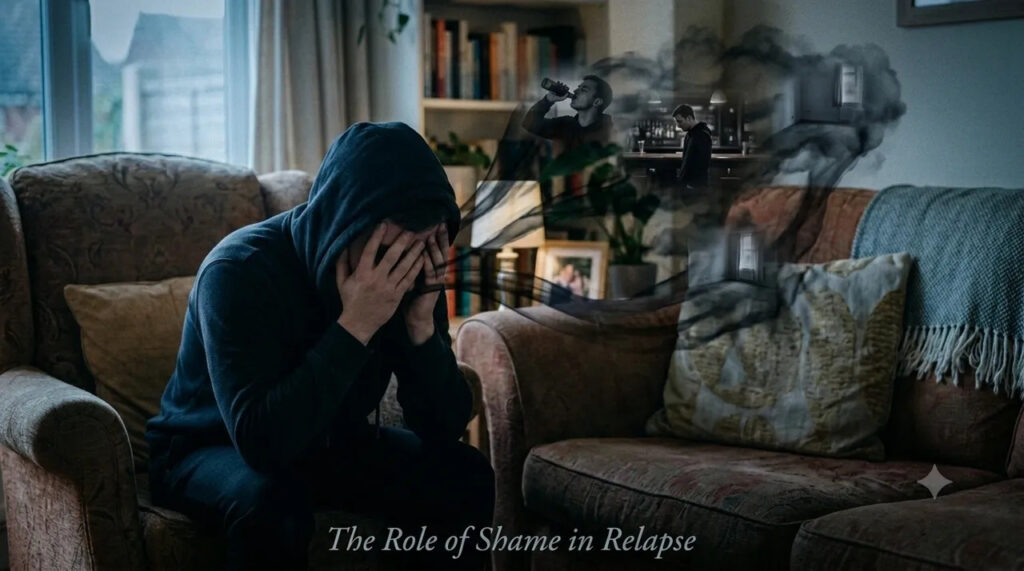
Shame is not the same as guilt. Guilt says I did something bad. Shame says I am bad. And shame is one of the most destructive forces in the recovery process.
Most people who relapse already know they have done something that contradicts their recovery goals. They do not need to be told that what they did was wrong. What they need is to be able to come back from it without the weight of total condemnation making that return feel impossible.
Research on addiction and recovery consistently shows that shame-based approaches to relapse do not work. They do not motivate change. They motivate hiding. When people feel that a relapse will result in complete rejection or devastating shame from the people they love, they are more likely to keep using in secret than to reach out for help.
This does not mean you are not allowed to feel hurt, disappointed, or angry. Those feelings are real and they are yours. But there is a difference between expressing your feelings honestly and delivering them in a way that is designed to make your loved one feel like a fundamentally broken person.
The question worth sitting with is this: do you want your loved one to feel punished, or do you want them to get help? Sometimes those two impulses pull in opposite directions, and you have to choose which one you are going to act on.
Taking Care of Yourself While Supporting Someone Through Relapse
A relapse affects everyone in the immediate circle. If you have been the primary support person for someone in recovery, a relapse can feel like a personal blow, like your efforts were not enough or did not matter. They did matter. And you need support right now too.
Some practical things that help:
Reach out to your own support network: A trusted friend, a family member, a therapist, or a support group specifically for loved ones of people with addiction. Al-Anon and Nar-Anon exist precisely for this moment. They are free, widely available, and staffed by people who understand this specific kind of pain because they have lived it.
Do not put your entire life on hold: When someone you love is in crisis, the instinct is to cancel everything and devote all of your energy to the situation. But as we discussed in the article on How to Support a Loved One in Recovery Without Burning Out, sustainable support requires that you maintain some structure and care for yourself. Abandoning your own needs entirely does not help your loved one. It depletes you.
Process your own grief: A relapse is a loss. It is the loss of the stability you thought was there, of the progress you thought was holding. As we explored in the article on Grief, Loss, and Recovery: How They Are Connected, grief in the context of recovery is real and it needs to be addressed rather than pushed down. Give yourself permission to feel it.
Revisit your boundaries: A relapse is a natural moment to assess what you are willing to continue doing and what you are not. This is not about punishment. It is about sustainability. If certain behaviors are not something you can continue to live with, now is the time to be honest about that, with yourself first and then with your loved one.
Remember that you did not cause this and you cannot control it: The three C’s taught in Al-Anon are worth repeating here. You did not cause the addiction. You cannot control it. You cannot cure it. What you can do is love the person, hold appropriate limits, and take care of yourself in the process.
When to Consider a Higher Level of Care
Not every relapse requires the same response. A single use after months of sobriety in someone who immediately reaches out for help is a very different situation from a full return to daily use that has been going on for weeks. Knowing when to push for a higher level of care is important.
Consider encouraging or facilitating a return to inpatient or intensive outpatient treatment if:
- The relapse has been going on for more than a few days
- Your loved one is not able to stop on their own and does not have strong enough outpatient support to help them do so
- There are physical health concerns related to the relapse
- Your loved one is expressing hopelessness or thoughts of self-harm
- The relapse involves substances that carry high overdose risk, including opioids or alcohol in someone with a history of heavy use
For women and mothers in Solano County who are in this situation, Hazel’s Tranquility Place in Vallejo provides transitional housing, sober living, and aftercare support in a structured, compassionate environment. Founded in 2019 by K. Patrice Williams after she witnessed the severe gaps in housing and programming for women and children in Solano County during her campaign for Solano County Supervisor, Hazel’s Tranquility Place offers exactly the kind of environment where women can stabilize after a setback and rebuild their recovery with real support around them.
Learn more at hazelstranquility.org.

What Recovery Looks Like After a Relapse
One of the most important things to know is that many people in long-term, sustained recovery have experienced one or more relapses on their way there. A relapse is not the end of the story. For many people, it becomes a turning point, the moment that clarified what was missing in their recovery and what needed to change.
What tends to come after a relapse for people who go on to achieve long-term recovery includes:
- An honest assessment of what triggered the relapse and what support gaps existed
- A return to or intensification of structured support, whether through meetings, therapy, or a care management program
- Adjustments to the living environment if that was a contributing factor
- Deeper engagement with the underlying emotional or trauma-based issues that contributed to the use
- A rebuilding of trust over time, not through promises but through consistent action
Recovery after relapse is possible. It happens every day for people across Solano County and across the country. The path back is not always easy or fast, but it exists and it is real.
You Are Not Alone in This
Supporting someone through a relapse is one of the hardest things a person can be asked to do. It requires you to hold love and boundaries at the same time, to stay present while also protecting yourself, and to keep hoping for someone when hope does not feel natural.
You do not have to do that alone. Solano Impact Care works with individuals and families in Solano County who are navigating exactly this kind of situation. Their team brings lived experience to every conversation, which means they understand what this moment feels like from the inside, not just from a clinical manual.
Reach out at (707) 301-4051 or email care@solanoimpactcare.org.
Whether you are the person in recovery or the person trying to hold it together while loving someone who is, support is available and you deserve access to it.
The Bottom Line
A relapse is not the end. It is not proof that your loved one cannot recover or that your support has been wasted. It is a setback in a long process, and like all setbacks, it carries information about what needs to change.
Your job right now is not to fix it. Your job is to stay grounded, respond with as much clarity and compassion as you can, get your loved one back into support as quickly as possible, and make sure you have support of your own.
That is enough. That is actually a lot. And it matters more than you know.
Reach out at (707) 301-4051 or email care@solanoimpactcare.org