For decades, low-income Californians enrolled in Medi-Cal faced a frustrating reality. Medical appointments, mental health services, housing support, and social programs all existed in separate systems that rarely talked to each other. A person dealing with homelessness, a substance use disorder, and a chronic health condition had to navigate multiple agencies, carry their own paperwork between appointments, and figure out on their own how to connect the dots. Most people fell through those gaps, and the consequences were serious.
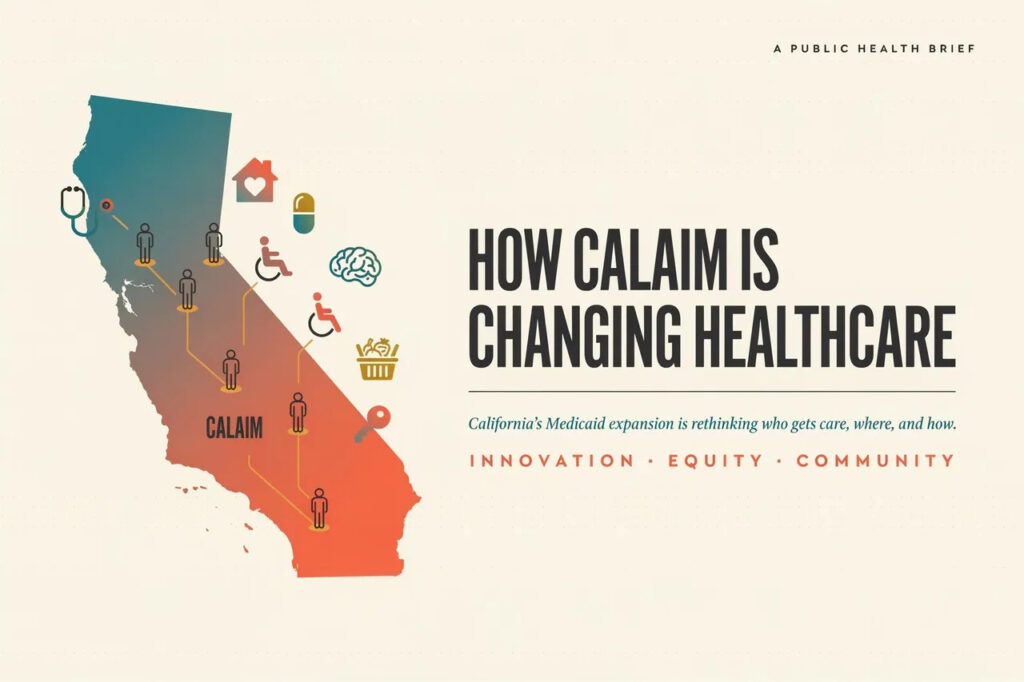
CalAIM, which stands for California Advancing and Innovating Medi-Cal, was launched to change that. In January 2022, the California Department of Health Care Services launched this major reform with the potential to improve outcomes for the millions of people enrolled in Medi-Cal, offering an unprecedented opportunity to move toward a more integrated and people-centered approach to care for people with the most complex health and social needs. This includes people experiencing homelessness, those with behavioral health conditions, and low-income older adults who have historically struggled to get coordinated support.
This article breaks down what CalAIM actually is, what it means for residents in Solano County, and how organizations like Solano Impact Care are delivering these services on the ground.
What CalAIM Actually Is
CalAIM is not just a policy update. It is a series of initiatives and reforms designed to create a more coordinated, person-centered, and equitable health system that works for all Californians, giving Medi-Cal members access to new and improved services that go beyond the doctor’s office or hospital and address physical and mental health needs.
Launched in 2022 and still rolling out, CalAIM represents California’s most ambitious Medicaid delivery system reform in a generation.
At its core, CalAIM is built around two major programs:
- Enhanced Care Management (ECM): A high-touch care management benefit for Medi-Cal members with the most complex needs
- Community Supports: A set of services that go beyond traditional medical coverage to address housing, food, recovery, and social stability
Together, these two programs are designed to treat the whole person, not just their diagnosis.
The Problem CalAIM Was Built to Solve
To understand why CalAIM matters, it helps to understand what was broken before it.
Too often, groups with the most complex needs have difficulty navigating the current Medi-Cal system, where a lack of coordinated care, including access to social supports, can lead to poor outcomes and inefficiency.
For someone living on the street in Vallejo or cycling in and out of the emergency room in Fairfield, the old system looked like this:
- A doctor treats a physical health condition but has no visibility into the patient’s housing situation
- A social worker helps with benefits but is not connected to behavioral health services
- A mental health provider sees someone weekly but has no way to coordinate with their primary care physician
- Nobody is responsible for making sure all of these pieces work together
The result was that the people with the greatest needs were receiving the most fragmented care. CalAIM was designed to close that gap.
Enhanced Care Management: What It Is and Who It Serves
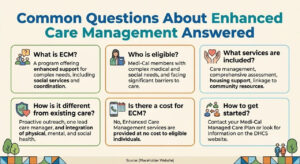
Enhanced Care Management is a new statewide Medi-Cal benefit available to select populations of focus that addresses the clinical and non-clinical needs of the highest-utilizing members through intensive coordination of health and health-related services. ECM meets members wherever they are, on the street, in a shelter, in their doctor’s office or at home. Members have a single lead care manager who coordinates care and services among the physical, behavioral, dental, developmental and social services delivery systems, making it easier for them to get the right care at the right time.
That last point is significant. One care manager, one point of contact, coordinating everything.
ECM is available for the following populations of focus:
- Adults, children, youth, and families experiencing homelessness
- Adults and children with or at risk for avoidable emergency department and hospital utilization
- Adults and children diagnosed with serious mental illness or substance use disorder
- Adults living in the community who are at risk for long-term care institutionalization
- Adult nursing facility residents transitioning to the community
- Adults and children with intellectual and developmental disabilities who also qualify for another ECM population of focus
- Justice-involved individuals
If you or someone you know falls into any of these categories and is enrolled in Medi-Cal, they may be eligible for ECM services at no cost.
For a detailed look at how ECM works and how to get connected in Solano County, read our earlier post on Need Help Navigating Medi-Cal in Solano County? Here is how ECM Helps.

Community Supports: Going Beyond Medical Care
Alongside ECM, CalAIM introduced Community Supports, which are services that Medi-Cal managed care plans can now offer to address the social and practical conditions that directly affect health outcomes.
Under CalAIM, Medi-Cal managed care plans can offer Community Supports such as housing navigation, medically tailored meals, and asthma remediation.
The full list of Community Supports includes services like:
- Housing navigation and move-in assistance
- Housing sustainability support to help members stay housed
- Post-hospitalization recovery support
- Transitional care following a hospital or facility stay
- Recuperative care for people experiencing homelessness who are recovering from an illness or injury
- Medically supportive food and nutrition assistance
- Personal care and homemaker services
What this means in practice is that a Medi-Cal member who needs help finding stable housing after a hospitalization can now receive that help as part of their healthcare plan, not as a separate service they have to hunt down on their own.
Why This Matters for Solano County Specifically
Solano County has a significant population of residents who qualify for CalAIM services. The county includes communities like Vallejo, Fairfield, Vacaville, Dixon, Suisun City, and Rio Vista, each with residents dealing with housing instability, substance use recovery, reentry from incarceration, and mental health needs.
Over 143,000 Medi-Cal members were served through ECM in the third quarter of 2024 alone, which reflects how rapidly the program is growing as more providers come online and more people learn they are eligible.
The challenge in many communities, including Solano County, is that knowing a program exists and actually accessing it are two different things. That is where local organizations like Solano Impact Care play a critical role.
How Solano Impact Care Delivers CalAIM Services
Solano Impact Care is one of the organizations in Solano County that provides both Enhanced Care Management and Community Supports to eligible Medi-Cal members. What makes their approach different is not just the services they provide, but the way they provide them.
As we explored in detail in our post on Why Solano Impact Care Is Different: Experience-Driven Community Care, the team is made up of individuals who have personally navigated homelessness, incarceration, substance use, and mental health challenges. They understand the systems their clients are trying to access because they have moved through those systems themselves.
This is not a small distinction. CalAIM is a powerful framework, but a framework only works if the people delivering it can actually connect with the individuals it is meant to serve. For someone who has had negative experiences with institutions, showing up to a program run by someone who has been through similar circumstances can make the difference between engaging and walking away.
The services Solano Impact Care provides through CalAIM include:
Enhanced Care Management:
- Comprehensive assessment and individualized care planning
- Care coordination across health and social services
- Health promotion and self-management support
- Transitional care assistance after hospital stays or facility discharge
- Member and family support
- Referrals to community and social supports
Community Supports:
- Housing navigation to help members find stable housing
- Housing sustainability support to help members remain housed
- Post-hospitalization recovery support
- Aftercare support following treatment

The Role of Community-Based Organizations in CalAIM
One of the most important structural changes CalAIM introduced is the formal inclusion of community-based organizations as providers. Several significant changes introduced within CalAIM create opportunities for traditionally revenue-tight community-based organizations to create an income stream to sustain their operations while expanding their care capabilities, particularly through ECM, Community Supports, and the Community Health Worker benefit.
This means organizations with deep roots in their communities, like Solano Impact Care, are now recognized as legitimate healthcare partners. Their work is not just supplementary. It is built into the system.
This shift also reflects something CalAIM acknowledges plainly: health outcomes are deeply connected to social conditions. Housing, employment, food access, and community connection are not separate from healthcare. They are part of it.
Hazel’s Tranquility Place: A Real-World Example of CalAIM in Action
One of the partner organizations connected to Solano Impact Care is Hazel’s Tranquility Place, a women and children’s transitional home based in Vallejo. The organization was founded in 2019 by K. Patrice Williams while she was running for Solano County Supervisor. During that campaign, she saw firsthand the housing and program gaps affecting women and children in the county and decided to do something about it.
Hazel’s Tranquility Place, which can be found at hazelstranquility.org, provides transitional housing, aftercare support, and sober living for vulnerable women and children in Vallejo and Solano County, with a focus on family reunification and long-term stability.
This kind of transitional housing is directly aligned with what CalAIM’s Community Supports program is designed to fund and support. A woman leaving incarceration or exiting a domestic violence situation who needs stable housing, sobriety support, and help reconnecting with her children is exactly the type of person CalAIM was built for. Organizations like Hazel’s Tranquility Place provide the environment where that stabilization can actually happen.
For women and families in Solano County who are in crisis, Hazel’s Tranquility Place and Solano Impact Care working together represent what CalAIM looks like when it reaches the people it was designed to serve.
What You Should Know If You or Someone You Know May Qualify
If you are a Medi-Cal member in Solano County, here is what you need to know about accessing CalAIM services:
- You do not need to apply separately for CalAIM. It operates through your existing Medi-Cal managed care plan, including Partnership HealthPlan and Kaiser.
- You need to be an active Medi-Cal member to receive ECM or Community Supports.
- A care manager or provider can submit a referral on your behalf, or you can reach out to an organization like Solano Impact Care directly to get connected.
- Services are provided at no cost to eligible members.
- ECM services can meet you wherever you are, including at home, in a shelter, or in the community.
If you are unsure whether you qualify or do not know where to start, calling Solano Impact Care at (707) 301-4051 or emailing care@solanoimpactcare.org is a good first step. The team will help you figure out what you are eligible for and walk you through the process.
The Bigger Picture
CalAIM is still being rolled out across California. The Justice-Involved Reentry Initiative went live in October 2024, and correctional facilities will continue to go live with pre-release services on a quarterly basis through October 2026, meaning new groups of people are becoming eligible for support on an ongoing basis.
The direction is clear. California is moving toward a system that treats the whole person, coordinates care across providers and systems, and brings services to people where they are rather than expecting people to navigate a maze on their own.
For residents of Solano County, that shift is already underway. The services are real, the organizations delivering them are local, and the people doing the work have lived experience that makes them uniquely qualified to help.
If you have been struggling and did not know help was available, this is the moment to find out what you qualify for.