If you have ever been told that you were being referred to a program, waited weeks to hear something, and then discovered nothing had actually happened, you already understand why this distinction matters.
Referrals and approved services are not the same thing. They are not even close to the same thing.But in the world of healthcare and social services, providers and agencies often treat them as though they are the same thing. And that gap, the space between a referral and an actual delivered service, is exactly where people fall through the cracks of systems that technically exist to help them.
Understanding the difference helps you ask better questions, advocate more effectively for yourself, and recognize when you need someone in your corner who will follow through.
What a Referral Actually Is
A referral is a recommendation. Nothing more and nothing less. When a doctor, social worker, case manager, or care coordinator refers you to a program or service, they are saying that in their judgment, that program or service may be appropriate for your situation. They are pointing you in a direction.
A referral does not guarantee access to a service. It does not confirm eligibility. Also, it does not mean an appointment has been scheduled. It does not mean funding has been approved. And it does not mean anyone at the receiving organization is expecting you or has your information.
In many cases, a referral is simply a piece of paper or a note in a system. It says someone suggested you contact a particular program. What happens next depends entirely on whether you follow up, Whether the receiving organization responds, whether you meet their eligibility criteria, and whether the service is actually available in your area at that time.
That is a lot of ifs. And for someone dealing with housing instability, mental health challenges, early recovery, or the overwhelming demands of reentry, navigating all of those ifs independently is genuinely difficult.
What an Approved Service Actually Is
One creates possibility. The other creates access.An approved service is a confirmed, authorized benefit you are entitled to receive. Someone has completed an eligibility determination. The relevant payer, in many cases a Medi-Cal managed care plan, has authorized it. A provider has been identified and connected. And the service is ready to begin.
Think about the difference this way. A referral is someone suggesting you might benefit from mental health support. An approved service is a confirmed appointment with a mental health provider whose services are covered and who is expecting you next Tuesday. One creates possibility. The other creates access.
Why Referrals So Often Do Not Lead to Services
The gap between referral and actual service delivery is one of the most well-documented failure points in healthcare and social services. Understanding why it happens helps explain why it is so common and why addressing it requires deliberate, active coordination.
The receiving organization may not have capacity: A referral to a program with a six-month waitlist does not produce a service in any meaningful timeframe. The referral may be technically accurate and appropriate. But it does not connect the person to help they can actually access now.
The person receiving the referral may not follow through: Following up on a referral requires energy, persistence, and organizational capacity. It requires phone calls, paperwork, and navigation of an unfamiliar system. For someone managing a mental health crisis, housing instability, or the demands of early recovery, that follow-through is often impossible without support.
Information does not transfer automatically: A referral made in one system does not automatically share your information with the receiving organization. You often have to re-explain your situation, re-submit documents, and re-establish context that your original provider already had. That repetition is exhausting and frequently causes people to disengage before the service ever begins.
Eligibility is not guaranteed: A referral is made based on a provider’s judgment that a service might fit. But eligibility is determined by the receiving organization according to their own criteria. A referral to a program you do not qualify for produces nothing except frustration and lost time.
Nobody follows through: This is the most common failure point of all. The referral is made. The note is written. The case is closed on the referring end. And nobody checks whether the connection actually happened. The person is left to navigate the gap alone, and often they cannot.
How Enhanced Care Management Closes the Gap
Enhanced Care Management exists in large part to address this exact problem. One of the core functions of a care manager is to transform referrals into actual services by following through on every connection until it is real, not just documented.
When a Solano Impact Care care manager identifies that a client needs a mental health provider, they do not write a referral note and move on. They identify the right provider. Also, they confirm that provider is accepting clients and that services are covered. They help schedule the appointment. Likewise, they remind the client beforehand. They follow up afterward to confirm the appointment happened and to identify any barriers that came up.
When a client needs housing navigation support through Solano Home Assist, the care manager does not hand them a phone number. They make the connection directly, share relevant context with permission, and coordinate between the two organizations to make sure the client’s housing needs are addressed as part of a coherent plan rather than a separate referral that may or may not connect.
That follow-through is the difference between a referral and an actual service. And it is one of the most significant ways that coordinated care management produces better outcomes than standard case management or self-navigation ever could.
As we covered in the article on Why Having One Care Team Can Make Getting Help Easier, the difference between support that works and support that does not is often not the quality of individual services. It is whether those services are connected, coordinated, and followed through on by someone who holds the full picture over time.
What This Looks Like for Medi-Cal Members
For Medi-Cal members in Solano County, the distinction between a referral and an approved service has specific practical implications.
Under CalAIM, both Enhanced Care Management and Community Supports are authorized benefits for eligible members. This means that when a Medi-Cal member qualifies for housing navigation, the service is not just a referral to a housing program. It is an approved benefit that is funded through their managed care plan and delivered by a qualified provider.
However, accessing an approved benefit still requires navigation. It requires someone to identify that the member qualifies, initiate the authorization process, connect them to the right provider, and follow through until the service is actually being delivered.
That is exactly what Solano Impact Care does. Their care managers do not just tell eligible members that services exist. They actively facilitate access to those services from eligibility determination through actual delivery.
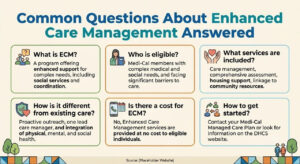
As we explored in the article on Common Questions About Enhanced Care Management Answered, ECM is available at no cost to eligible Medi-Cal members. And the care managers delivering it are responsible not just for making referrals but for ensuring that every referral becomes an actual, delivered service.
Questions to Ask When You Receive a Referral
If you are navigating the social services or healthcare system in Solano County and you receive a referral, these questions help clarify what you are actually being given and what follow-through looks like.
Is this a referral or an approved service? Ask directly. Understanding which one you are receiving sets accurate expectations.
What are the next steps on your end? A referral that requires you to call, apply, and navigate independently is very different from a connection that your care manager is actively facilitating.
How long does this process typically take? If the program has a long waitlist, knowing that upfront helps you plan rather than wait in a vacuum.
Will you follow up to make sure this connects? If the answer is no, you know that the follow-through responsibility is on you and you can prepare accordingly.
What happens if I cannot get through or the program is not available? Understanding the backup plan before you need it matters.
Is there someone who can help me navigate this if I run into barriers? If the answer is no, that is a signal that you may need a care manager who can provide that support.
Why This Matters for People With Complex Needs
For people with straightforward, single needs, a referral may be sufficient. They have the capacity to follow up, the organizational ability to navigate the system, and the circumstances to sustain persistence through a process that takes time.
But for people dealing with multiple, overlapping challenges simultaneously, a referral is rarely enough. The same circumstances that create the need for multiple services also create the barriers to independently converting those referrals into actual access.
This is why Enhanced Care Management specifically targets people with complex needs. Not because simpler needs are less important but because complex needs require a level of active coordination that a referral system cannot provide.
For a person leaving incarceration with no housing, a mental health history, and a substance use disorder, a stack of referrals produces very little. What produces outcomes is a care manager who holds all of those referrals simultaneously, follows through on each one, and coordinates between them to make sure the pieces of the care plan are actually working together.
The Solano Impact Care Approach to Follow-Through
At Solano Impact Care, follow-through is not optional. It is the job.
The team personally knows what it feels like to receive a referral that goes nowhere. They understand the specific frustration of being told help is available and then discovering that the gap between the referral and the actual service is wider than anyone acknowledged. That lived experience drives a different standard of practice at Solano Impact Care.
Every care manager tracks every referral they make. They follow through on every connection. When a barrier arises between a referral and a delivered service, they address it actively rather than document it and leave the client to resolve it alone.
That standard shows up in how Solano Impact Care coordinates within its network of partner organizations. When care managers connect clients to Solano Home Assist for housing support, Match2Hire for employment, Solano EmpowerTech for digital skills training, or Hazel’s Tranquility Place for women needing transitional housing and sober living support, they are not making referrals on paper. They are building coordinated connections between organizations that have genuine working relationships, designed specifically to move clients from referral to actual service without losing them in the gap between the two.
Hazel’s Tranquility Place is a structured, supportive housing program in Solano County created to help people stabilize during vulnerable transitions. It is a transitional and sober living home in Vallejo founded by K. Patrice Williams, providing a safe haven and support services for women reentering the community from incarceration or recovering from substance use. Founded in 2019 while K. Patrice Williams was running for Solano County Supervisor, after she witnessed firsthand the gaps in housing and support for women and children in Solano County, Hazel’s Tranquility Place was built directly in response to what she saw. Learn more at hazelstranquility.org.
Getting Support That Actually Connects
If you are a Medi-Cal member in Solano County and you are tired of referrals that lead nowhere, Enhanced Care Management through Solano Impact Care provides the coordinated follow-through that transforms referrals into actual, delivered services.
You do not have to navigate the gap between referral and access alone. That is exactly what a care manager is there to close.
Call (707) 301-4051, email care@solanoimpactcare.org, or visit solanoimpactcare.org/get-started to get connected.