
Most people think resilience is something you either have or you do not. You watch someone walk through something devastating and keep going, and you wonder what they are made of that you are not. What you are not seeing is the work that happened before that moment. The small, unglamorous, daily choices that built the capacity to absorb a hard hit and keep standing.
Emotional resilience is not a personality trait. It is a practice. It is built slowly, through habits that seem almost too simple to matter until one day you realize you are handling something that would have destroyed you two years ago.
This article covers five daily habits that research and real-world experience show actually build emotional resilience over time. Not overnight. Not dramatically. But genuinely, steadily, and in ways that compound into something lasting.
Why Daily Habits Matter More Than Big Moments
Before getting into the habits themselves, it is worth understanding why daily practice matters more than occasional big efforts.
Resilience is built in the nervous system. It is the result of repeated experiences of stress followed by recovery, of difficulty followed by getting through it, of reaching for support and finding it there. Each time that cycle completes, the nervous system becomes slightly more capable of handling the next round.
This is why one retreat, one therapy session, or one breakthrough moment, as valuable as those things are, does not build resilience on its own. What builds it is the slow accumulation of daily choices that train the mind and body to respond to difficulty differently over time.
For people in recovery, returning from incarceration, or rebuilding after homelessness, this matters enormously. You may not be able to control your circumstances right now. But you can control your daily habits. And those habits, practiced consistently, will build something inside you that circumstances cannot easily take away.

Habit One: Start the Day With Intention, Not Reaction
Most people begin their day by immediately reacting to whatever is in front of them. A phone notification, a worry that surfaced overnight, the noise of a shelter or a crowded household, the anxiety about what the day holds. The day begins in reactive mode and often stays there.
Starting the day with even five minutes of intentional practice changes that dynamic. It does not have to be elaborate. What matters is that you create a brief window between waking up and reacting, where you make a conscious choice about how you want to meet the day.
What this can look like:
- Sitting quietly for five minutes before picking up your phone
- Writing down one thing you are working toward and one thing you are grateful for
- Taking ten slow, deliberate breaths before getting up
- Reading one paragraph of something that grounds or inspires you
- Saying out loud, or writing down, one intention for the day
The content of the practice matters less than the consistency of doing it. Over time, starting the day with intention rather than reaction trains the brain to approach difficulty with a slight pause before responding, which is one of the most practical definitions of emotional resilience in action.

Habit Two: Move Your Body Every Day, Even Briefly
The connection between physical movement and emotional resilience is one of the most well-documented findings in mental health research. Exercise reduces cortisol, the body’s primary stress hormone. It increases dopamine and serotonin, which are the neurochemicals most directly associated with mood stability and emotional regulation. It also helps process stored tension and stress that the body holds from difficult experiences.
You do not need a gym. You do not need equipment. You do not need an hour.
What counts as movement that builds resilience:
- A twenty minute walk outside, especially in natural light
- Stretching for ten minutes in the morning
- Doing push-ups, sit-ups, or bodyweight exercises in whatever space you have
- Dancing to music that lifts your mood
- Any physical activity that gets your heart rate up even slightly and lasts at least fifteen minutes
For people in early recovery or dealing with significant mental health challenges, movement can feel like the last thing you have energy for. Start smaller than you think you need to. Five minutes of walking is not nothing. It is a habit being planted. And habits, once planted, grow.
The goal is not fitness. The goal is to give your nervous system a daily reset that makes everything else slightly more manageable.

Habit Three: Connect With at Least One Person Every Day
Isolation is one of the most consistent predictors of poor mental health outcomes and one of the biggest barriers to resilience. Human beings are wired for connection. The nervous system literally regulates itself through safe contact with other people. When that contact is absent, everything becomes harder: managing emotions, maintaining hope, sustaining motivation, and bouncing back from setbacks.
Daily connection does not have to be deep or long. It just has to be real.
What daily connection can look like:
- A genuine conversation with someone in your sober living home or shelter
- A check-in call or text with a sponsor, peer support worker, or family member
- Attending a recovery meeting and speaking, even briefly
- A real exchange with a care manager or case worker
- Showing up to a community group, class, or program where you are known by name
The key word is genuine. Scrolling through social media does not count. Passive consumption of other people’s content does not provide the nervous system regulation that comes from real human contact. A five minute honest conversation does more for your emotional resilience than two hours of scrolling.
As we covered in the article on What Is a Resilience-Building Program and Who Is It For?, one of the most consistent findings in resilience research is that people with strong social connections recover from adversity more effectively than those who go it alone. Daily connection is how you build and maintain that network one day at a time.
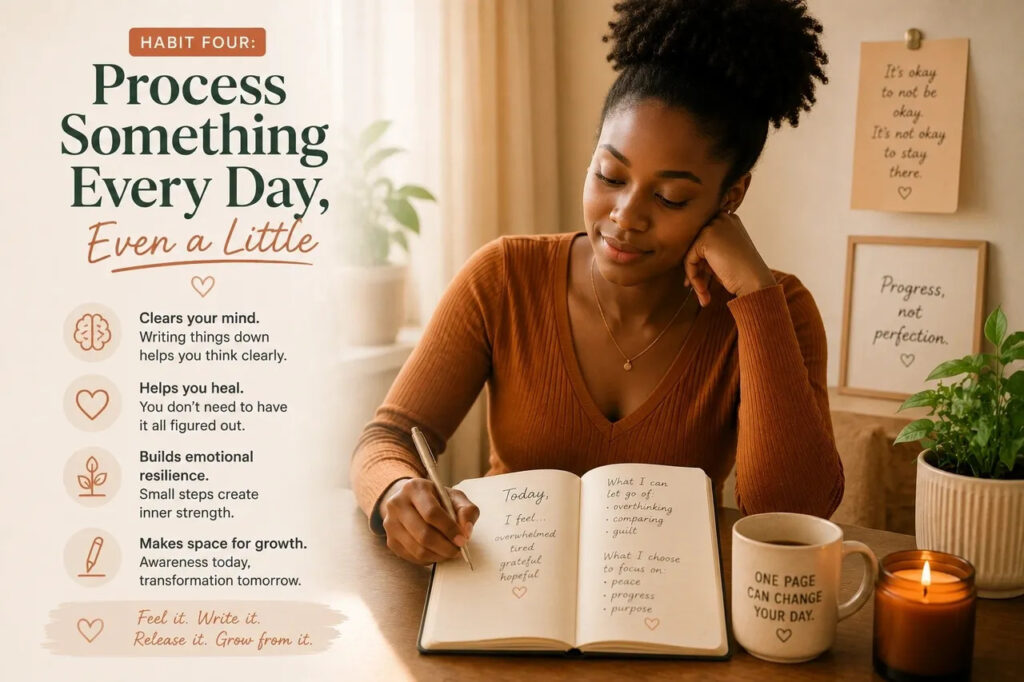
Habit Four: Process Something Every Day, Even a Little
Unprocessed emotion does not disappear. It accumulates. It shows up as irritability, numbness, anxiety, or eventually a breakdown that seems to come out of nowhere but has actually been building for months. One of the most important daily habits for emotional resilience is creating a small, consistent outlet for processing what you are carrying.
This does not require a therapist, though therapy is valuable when accessible. It requires a practice.
Options for daily emotional processing:
- Journaling. Even three to five sentences at the end of the day. What happened, how you felt about it, and what you want to do differently tomorrow. It does not need to be polished or profound. It just needs to be honest.
- Talking it through. A brief honest conversation with a trusted person about what you are carrying. Not venting without direction, but actually naming what you felt and why.
- Prayer or meditation. For people with a spiritual practice, this can be a powerful daily processing tool. The act of bringing what you are carrying into a larger context, of releasing it rather than holding it alone, is genuinely effective for many people.
- Creative expression. Drawing, music, writing, building something with your hands. Creative activity gives emotion a form and a direction, which helps process it rather than letting it sit unexamined.
The goal is not to solve everything you are feeling. The goal is to make sure emotions are moving rather than accumulating. As we explored in the article on Grief, Loss, and Recovery: How They Are Connected, unprocessed emotional weight builds pressure over time and tends to surface in ways that are harder to manage the longer they are avoided. A small daily practice keeps that from happening.
Habit Five: End the Day With Something That Restores You
How you end a day matters for how you begin the next one. Most people in difficult circumstances end their days in one of two ways: either lying awake cycling through worry and stress, or collapsing from exhaustion without any intentional transition between the intensity of the day and rest.
Neither of those prepares the nervous system for genuine restoration.
Building a simple end-of-day routine that signals to your body and mind that it is safe to rest is a habit that builds resilience over time by improving sleep quality, reducing chronic stress, and creating a daily experience of intentional self-care that reinforces your own worth and wellbeing.
What an end-of-day restoration habit can look like:
- Reading something calming or uplifting for fifteen minutes before sleep
- Writing down three things that happened during the day that you can acknowledge, however small
- A brief stretching or breathing routine that releases physical tension
- Listening to calming music or a podcast that helps your mind wind down
- Reviewing the one intention you set at the start of the day and acknowledging whether you moved toward it
The content matters less than the consistency. You are training your brain to associate the end of the day with intentional rest rather than unmanaged anxiety. Over time that training produces measurably better sleep, lower baseline stress, and greater capacity to handle what the next day brings.
These Habits Work Together
Each of these five habits builds resilience individually. Together they create something more powerful than the sum of their parts. They address the nervous system through movement, the mind through intention and processing, the relational foundation through daily connection, and the body’s capacity for restoration through intentional rest.
None of them require money. None of them require perfect circumstances. All of them can be practiced in a shelter, in early recovery, in a transitional housing program, or in the first weeks after release from incarceration.
They also build on each other. People who start their day with intention tend to move more consistently. People who move consistently sleep better. People who sleep better connect more genuinely. People who connect genuinely process their emotions more effectively. The habits create a cycle of resilience that grows stronger the longer it runs.

Getting Support in Solano County
Building these habits is easier with support around you. For Medi-Cal members in Solano County, Solano Impact Care provides Enhanced Care Management and Community Supports that help coordinate the practical and emotional dimensions of rebuilding. Their team brings lived experience with homelessness, incarceration, substance use, and mental health challenges, which means the support they offer is grounded in genuine understanding of what daily resilience-building looks like when you are starting from very little.
For women and mothers in Vallejo and Solano County who need a stable, structured environment where these habits can actually take root, Hazel’s Tranquility Place offers transitional housing, sober living, and aftercare support built around long-term recovery and family stability. Founded in 2019 by K. Patrice Williams after she witnessed the gaps in housing and programming for women and children in Solano County during her campaign for Solano County Supervisor, Hazel’s Tranquility Place is the kind of environment where daily habits become possible because the foundation beneath them is safe. Learn more at hazelstranquility.org.
To connect with Solano Impact Care, call (707) 301-4051 or email care@solanoimpactcare.org.
Start With One
You do not have to build all five habits at once. In fact, trying to implement everything simultaneously is one of the fastest ways to implement nothing. Pick one habit from this list. The one that feels most accessible, or the one that addresses what you most need right now.
Do it for two weeks before adding another. Let it become familiar before expanding. Build slowly and consistently, the same way resilience itself is built.
One habit, practiced daily, will begin to change something. And that change, however small it seems at first, is the beginning of everything else.