There is a word that gets used a lot in recovery and mental health spaces. Resilience. You hear it in treatment programs, in therapy sessions, in motivational posts, and in community meetings. Sometimes it gets said so often it starts to lose its meaning, becoming one of those words that sounds good but does not actually tell you anything.
So let us be specific. Resilience is not the ability to avoid hard things. It is not the ability to stay strong and never break down. It is not something you either have or you do not. Resilience is a set of skills, habits, connections, and internal resources that allow a person to face difficulty, absorb the impact, and find a way to keep moving forward. It is built over time, through experience, through support, and through intentional work. And it can be developed by anyone, at any point in their life, regardless of where they are starting from.
A resilience-building program is a structured approach to developing exactly that. It is not a magic fix. It is not a one-time workshop or a motivational seminar. It is an ongoing process of building the practical and emotional tools that allow a person to navigate life’s hardest chapters without falling apart or giving up.
This article explains what resilience-building programs look like, who they are designed for, and why the approach matters as much as the content, especially for people in Solano County who have been through experiences that most programs were never designed to address.
What Resilience Actually Looks Like in Practice
Before getting into what a resilience-building program does, it helps to understand what resilience actually looks like when it is working in someone’s life. Because the popular image of resilience, the person who bounces back instantly, never shows weakness, and powers through everything alone, is not just unrealistic. It is genuinely harmful. It sets a standard that no human being can actually meet and makes people feel like failures when they struggle.
Real resilience looks more like this:
- Being able to feel the full weight of a difficult situation without being destroyed by it
- Reaching out for help when you need it instead of isolating
- Finding meaning in hard experiences rather than being defined by them
- Recovering from setbacks without giving up entirely on the progress you have made
- Maintaining enough stability in your daily life to keep functioning even when things are painful
- Building and maintaining relationships that provide genuine support
- Developing the ability to regulate your emotions instead of being controlled by them
- Holding onto a sense of hope and possibility even when the present moment is very dark
None of those things happen automatically. They are learned. They are practiced. And they are supported by the people and environments around you, which is exactly why resilience-building programs exist.
What a Resilience-Building Program Actually Includes
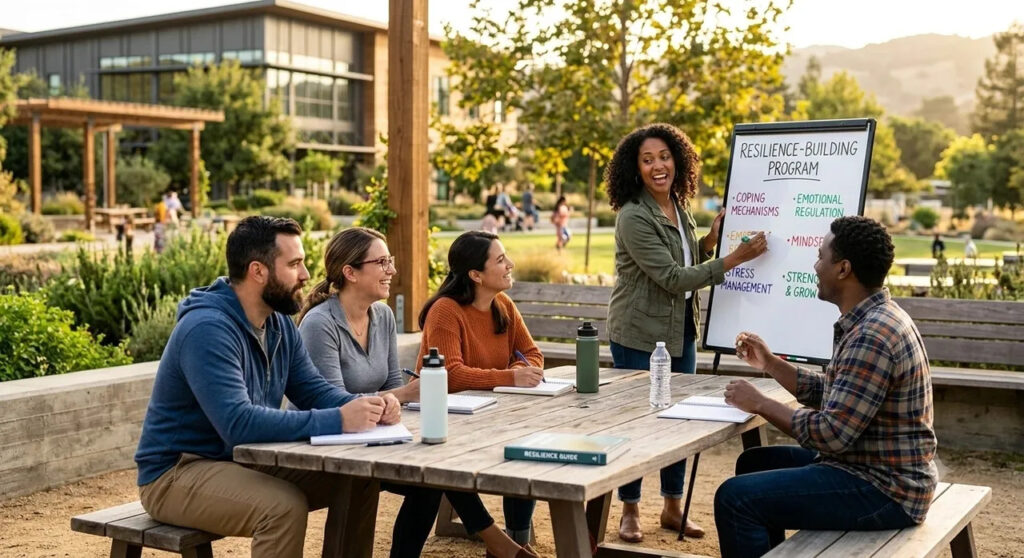
Resilience-building programs vary in structure and format depending on who they serve and what setting they operate in. But the most effective ones tend to share a common set of components that research and real-world experience have shown actually move the needle.
Emotional regulation skills
Learning to identify what you are feeling, understand where it is coming from, and respond to it in a way that does not make things worse. This sounds simple. For many people, especially those who grew up in environments where emotions were not safe to express, it is genuinely one of the hardest skills to develop.
Coping strategies that actually work
Not just being told to take deep breaths, but developing a real toolkit of ways to manage stress, anxiety, grief, and anger without turning to substances or other harmful behaviors. This includes both immediate strategies for acute moments and longer-term habits that build emotional stamina over time.
Trauma processing
For many people in resilience-building programs, unresolved trauma is the root of the challenges they are trying to overcome. A good program creates space to address that trauma in a structured, supported way rather than asking people to build resilience on top of wounds that have never been acknowledged. As we explored in the article on Grief, Loss, and Recovery: How They Are Connected, unprocessed grief and trauma do not disappear. They drive behavior. Resilience-building that does not address underlying trauma tends not to hold.
Connection and community
Isolation is one of the most significant barriers to resilience. Programs that bring people together, whether in group settings, peer support circles, or community activities, build the relational foundation that resilience depends on. Human beings are wired for connection, and research consistently shows that people with strong social support networks recover from adversity more effectively than those who go it alone.
Goal setting and practical life skills
Resilience is not just emotional. It is also practical. Programs that help people set realistic goals, build daily routines, develop financial literacy, navigate systems, and access resources are building resilience in a concrete, tangible way. Having a plan for what comes next, even an imperfect one, provides a sense of agency and direction that is itself a resilience resource.
Identity and meaning-making
Some of the most powerful resilience work happens when people are supported in developing a new understanding of their own story. Not denying what happened, but finding a way to understand it that does not leave them defined entirely by their hardest moments. People who have moved through serious adversity and found meaning in that experience, who have turned their pain into purpose, tend to show some of the strongest resilience outcomes of anyone.
Who Resilience-Building Programs Are For
The honest answer is that resilience-building is relevant to almost anyone navigating a significant life challenge. But these programs are particularly well-suited for people who are dealing with one or more of the following:
People in recovery from substance use
Recovery is not just about stopping the use of a substance. It is about building a life that does not require escaping. As we covered in the article on How Long Does Recovery Actually Take? What the Research Says, the process of rebuilding a full, functional life after addiction takes years, not weeks. Resilience-building programs provide the skills and support that make that rebuilding process sustainable.
People who have experienced homelessness
Losing housing is one of the most destabilizing things a person can experience. It strips away privacy, safety, routine, and a sense of belonging. Rebuilding after homelessness requires more than just a roof. It requires the emotional and practical tools to maintain that stability once it is established.
Formerly incarcerated individuals
Returning from incarceration means rebuilding almost every aspect of a life, employment, housing, relationships, identity, and community belonging, often while carrying the weight of stigma and limited resources. Resilience-building programs designed for this population understand those specific challenges and address them directly.
People with trauma histories
Adverse childhood experiences, domestic violence, community violence, sudden loss, and other traumatic events leave lasting imprints that affect how a person responds to stress, relates to others, and believes in their own capacity to handle difficulty. Trauma-informed resilience work is specifically designed to address those imprints.
Women and mothers in crisis
The complexity of navigating recovery, family reunification, housing, and mental health simultaneously asks more of a person than almost any other set of circumstances. Resilience programs designed specifically for women understand that complexity and provide support that addresses it from the inside out.
Anyone who feels stuck
Sometimes the person who most needs a resilience-building program is not in an acute crisis. They are just someone who has been struggling in the same patterns for a long time and cannot figure out how to break out of them. Resilience-building provides the tools and support to do exactly that.
Why the Approach Matters as Much as the Content
Here is something that often gets overlooked when people talk about resilience-building programs. The actual content of the program, the curriculum, the skills, the techniques, matters. But the way that content is delivered matters just as much, and in some cases more.
Research on what makes support effective for people who have experienced significant trauma and adversity consistently points to the same factors: the quality of the relationship between the person seeking help and the person providing it, the degree to which the person feels genuinely seen and understood, and the extent to which the support is built on trust rather than judgment.
This is where Solano Impact Care does something that most programs cannot replicate.
The team at Solano Impact Care is made up of individuals who have personally navigated homelessness, incarceration, mental health crises, substance use, and profound loss. They are not reading about these experiences from a clinical manual. They have lived them. They have sat in the same waiting rooms, navigated the same systems, felt the same shame, and found their own way through to the other side.
That shared experience changes the entire dynamic of what support feels like. When your care manager has been where you are, you do not have to spend energy explaining yourself or bracing for judgment. You can get straight to the work. The trust that usually takes months to build in a traditional clinical relationship can form much faster when it is grounded in genuine mutual understanding.

What Solano Impact Care’s Resilience-Building Approach Looks Like
Solano Impact Care’s resilience-building work is woven through everything they do, not siloed into a separate program that people attend once a week and then leave behind. It shows up in the way care managers engage with clients, in the environment that is created during every interaction, and in the specific components that make up their broader support framework.
Their approach centers on five things:
Creating supportive, understanding environments
Every point of contact is designed to feel safe, not clinical and transactional. People are met with warmth and without preconditions.
Connecting individuals to vital resources
Resilience does not develop in a vacuum. It grows when people have what they need. Connecting clients to housing, healthcare, employment support, peer community, and social services builds the practical foundation that emotional resilience depends on.
Developing sustainable community networks
The goal is not to create dependency on a single organization. It is to help people build a web of connections and resources that supports them long after direct services end.
Addressing systemic barriers
Many of the challenges Solano Impact Care clients face are not just personal. They are systemic. A team with lived experience understands those barriers from the inside and knows how to help people navigate around them, through them, or in spite of them.
Empowering personal transformation
The end goal of every interaction is not compliance or crisis management. It is the client’s own growth, agency, and long-term wellbeing, including their physical health, mental health, and social connections.
The Role of Local Roots in Resilience Work
One of the things that makes Solano Impact Care distinctly effective for residents of Solano County is that the organization is genuinely local. The team was born and raised in this county. They know Vallejo, Fairfield, Vacaville, Dixon, Suisun City, and Rio Vista not as service delivery zones but as home.
That matters for resilience work specifically because so much of resilience is built through community belonging, knowing the resources in your area, understanding the specific challenges your neighborhood faces, and feeling like you are part of something larger than your own struggle.
A team with deep local roots can connect people to resources that do not show up in a Google search. They can navigate the specific gaps in Solano County’s service landscape because they have experienced those gaps themselves. They can speak with authority about what is actually available and what actually works, not just what theoretically exists on a services map.
For women and mothers in Vallejo specifically, that local knowledge connects directly to resources like Hazel’s Tranquility Place, the transitional housing and sober living program founded in 2019 by K. Patrice Williams after she witnessed firsthand the gaps in housing and support for women and children in Solano County during her campaign for Solano County Supervisor. Hazel’s Tranquility Place offers exactly the kind of stable, structured, and compassionate environment where resilience work can genuinely take root. Learn more at hazelstranquility.org.
Resilience Is Proof That Change Is Possible
At the heart of everything Solano Impact Care does is a belief that is not just philosophical. It is lived. Change is possible. Recovery is possible. Rebuilding is possible. The people doing this work are proof of that, not because they have perfect stories, but because they are standing on the other side of some of the hardest chapters a person can live through, and they came back.
That proof matters enormously for someone who does not yet believe it is possible for them. One of the most powerful predictors of a person’s ability to build resilience is whether they can hold even a small amount of hope that things can be different. When the person across from you has been where you are and came through it, that hope becomes a little more real and a little more possible to hold onto.
If you are in Solano County and you are ready to start building something stronger, or if you have been trying for a long time and the right support has not shown up yet, reach out to Solano Impact Care. The team is here, they understand what you are carrying, and they know the way forward.
Call (707) 301-4051 or email care@solanoimpactcare.org to get connected.