
When everything feels like it needs attention at once, figuring out where to begin can feel paralyzing. Housing is unstable. Mental health is suffering. Recovery is fragile. Employment feels out of reach. And somewhere underneath all of it, trauma is running the show in ways that are not always easy to identify.
Most people in this situation do one of two things. They try to tackle everything simultaneously and quickly become overwhelmed. Or they freeze entirely, unable to prioritize because everything feels equally urgent and equally impossible.
Neither approach gets traction. And neither is the right starting point.
The right starting point is simpler than most people expect. And this article walks you through exactly what it looks like.
Photo by Land O’Lakes, Inc. on Unsplash
First, Understand That You Do Not Have to Figure This Out Alone
The most important shift to make before anything else is this one. Figuring out where to start when you need multiple types of support is not your job alone. It is the job of coordinated support systems that exist specifically for this purpose.
You are not expected to assess your own situation objectively, identify which services apply to your circumstances, navigate the application processes for each one, and coordinate between them while also managing the crisis that brought you here. That expectation is unreasonable. And it is one of the primary reasons so many people fall through the gaps of systems that technically exist to help them.
When multiple needs are present simultaneously, the starting point is connecting with an organization that can hold the full picture and help you figure out what comes next. In Solano County, that organization is Solano Impact Care.
Start With Safety and Stabilization
Before anything else can be addressed effectively, basic safety and stabilization need to be in place. This is not a rule someone made up. It is how human beings actually function. When a person is in acute crisis, the brain’s capacity for planning, decision making, and long-term thinking is significantly reduced.
Stabilization means different things for different people. For someone experiencing homelessness, it means getting into a safe place to sleep. Also, for someone in active mental health crisis, it means getting immediate support and reducing the intensity of that crisis. For someone in early recovery, it means having a substance-free environment and at least one consistent support. For someone leaving incarceration, it means having an address, identification documents, and a basic plan for the first week.
These stabilization needs are addressed first not because everything else is less important but because without them, everything else is harder to engage with. As we explored in the article on Setting Goals When You Have Lost Everything: A Practical Guide, sustainable rebuilding happens in layers. Stabilization is the first layer. Everything else builds from there.
Then, Get a Comprehensive Assessment
Once basic stabilization is in place or being actively pursued, the next step is a comprehensive assessment. This is a structured conversation with a care manager who looks at the full picture of your situation rather than just one dimension of it.
A good assessment covers:
- Your current housing situation and what stability looks like for you
- Your physical health needs and who is currently providing care
- Your mental health history and current status
- Substance use history and current recovery status if relevant
- Your employment situation and what barriers exist to work
- Your social support network and where it is strong or absent
- The practical barriers you are facing including documentation, transportation, and income
- Your own goals and what a better life looks like to you specifically
This assessment is not a test. Nothing about it determines whether you deserve help. It is the foundation of a care plan that is built around your actual situation rather than a generic template that does not fit your life.
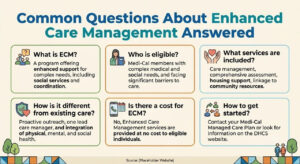
Solano Impact Care conducts this kind of comprehensive assessment for eligible Medi-Cal members in Solano County through their Enhanced Care Management program. Their care managers bring lived experience of homelessness, incarceration, substance use, and mental health challenges to every assessment. That shared background means they understand your situation not just professionally but personally. Trust builds faster. Honesty comes more easily. And the resulting care plan reflects a more accurate picture of what is actually going on.
Let the Assessment Drive the Priorities
After the assessment, the care plan identifies priorities. Not everything can be addressed with the same intensity at the same time. But everything is held in view simultaneously so that progress in one area is coordinated with progress in others.
Priorities typically emerge naturally from the assessment. Housing instability is almost always an early priority because it affects everything else. Mental health and substance use needs that are creating immediate risk also rise to the top. Employment tends to become a priority once housing and health are more stable, because pursuing work while in acute crisis is rarely sustainable.
This sequencing is not rigid. Life does not pause while one system does its work. A care manager holds the coordination across all priorities simultaneously, adjusting as circumstances change rather than locking into a sequence that stops making sense the moment reality shifts.
As we covered in the article on Why Housing, Employment, and Health Support Should Work Together, these dimensions are deeply interconnected. Addressing them in a coordinated way rather than one at a time produces significantly better outcomes than sequential approaches that treat each need as separate from the others.
Connect to the Right Resources for Each Need
Once priorities are clear, the care manager connects you to the specific resources that address each one. In Solano County, that network of resources is more connected than most people realize.
For housing needs, Solano Impact Care coordinates with Solano Home Assist, which provides specialized housing counseling and navigation support. Together they address not just finding housing but sustaining it over time through practical education and ongoing support.
For employment needs, the network includes Match2Hire, a registered nonprofit that bridges the gap between job seekers and employers with a specific focus on people who face real barriers. Likewise, for those who need digital skills before employment is realistic, Solano EmpowerTech provides digital literacy workshops and job readiness training tailored specifically for justice-involved individuals.
For women who need transitional housing alongside recovery support, Hazel’s Tranquility Place in Vallejo provides a structured, supportive residential environment where rebuilding can happen in safety and community. Founded in 2019 by K. Patrice Williams after she witnessed firsthand the serious gaps in housing and programming for women and children in Solano County during her campaign for Solano County Supervisor, Hazel’s Tranquility Place offers women a place where all three pillars of rebuilding, housing, health, and employment preparation, are supported simultaneously. Learn more at hazelstranquility.org.
For community capacity and civic engagement, BrandGOV and Empower Solano address the broader dimensions of community belonging and economic participation that matter for long-term stability beyond the immediate rebuilding phase.
Stay Connected Through the Process
One of the most important things about starting with coordinated support is that it does not end after the first appointment or the first referral. The care manager stays involved. They follow through on connections. Also, they troubleshoot when something does not work. They adjust the care plan when circumstances change. And they check in consistently rather than disappearing once a referral is made on paper.
This ongoing presence matters enormously. Because rebuilding is not a straight line. Setbacks happen. Referrals fall through. New challenges emerge. Having a consistent point of contact who holds the full picture means that when things get harder, which they will at some point, you are not starting over from zero. You are working through a bump in a process that is still moving forward.
The First Step Is Simpler Than It Feels
When you need multiple types of support, the starting point is not a comprehensive plan. It is not a prioritized list of everything that needs to happen. It is one conversation with someone who can help you figure out the rest.
That conversation is available right now through Solano Impact Care. Their team serves Medi-Cal members across Solano County including Vallejo, Fairfield, Vacaville, Dixon, Suisun City, and Rio Vista. They meet people where they are, literally and figuratively. And they bring a level of understanding to that first conversation that makes it feel less like an intake process and more like talking to someone who genuinely gets it.
Because they do get it. Many of them have been exactly where you are. And they found their way through. That is not a sales pitch. It is the lived reality of the team that will answer when you call.
Call (707) 301-4051, email care@solanoimpactcare.org, or visit solanoimpactcare.org/get-started to take the first step.
You do not have to have everything figured out. You just have to make the call.