
Rebuilding a life is not a single task. It is not something that happens in one program, one appointment, or one conversation. It is a process that involves multiple dimensions of a person’s existence, all needing attention at the same time, all affecting each other in ways that make addressing any one of them in isolation deeply insufficient.
Housing affects recovery. Recovery affects mental health. Mental health affects employment. Employment affects housing. Trauma runs underneath all of it. And when any one of these pieces is missing or unstable, the others become harder to hold.
This is why coordinated support matters. Not because individual services are not valuable. They are. But because the people who rebuild most successfully are almost never the ones who got one thing fixed at a time. They are the ones who had support that saw the whole picture and addressed it together.
In Solano County, that kind of coordinated support exists. And this article explains exactly what it looks like, why it works, and how to access it.
Photo by Nick Fewings on Unsplash
What Coordinated Support Actually Means
Coordinated support is not the same as having multiple services. A person can be connected to five different programs and still experience complete fragmentation if none of those programs are communicating with each other or working toward shared goals.
True coordinated support means:
- One person or team holds the full picture of a client’s situation
- Services across health, mental health, housing, and social needs are actively connected rather than operating in parallel silos
- Referrals are followed through rather than made on paper and forgotten
- The client’s own goals drive the coordination rather than program requirements
- Transitions between services and systems are actively managed rather than left to the client to navigate alone
- Problems in one area are understood in the context of their effects on other areas
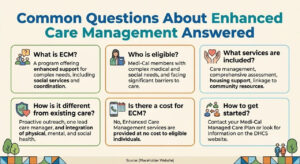
This is what Enhanced Care Management is designed to provide. And it is what Solano Impact Care delivers in Solano County for eligible Medi-Cal members every day.
Why Fragmented Support Often Fails
To understand why coordinated support works, it helps to understand why fragmented support so often does not.
Consider what rebuilding typically requires. A person leaving incarceration needs identification documents, housing, income, mental health support, substance use recovery support if relevant, transportation, and employment. Each of these is addressed by a different program or agency. Each program has its own application process, its own eligibility criteria, its own waitlist, and its own definition of what its job is.
Nobody is responsible for making sure all of these things happen together. The person themselves is expected to navigate each system independently. While also managing the stress of reentry. Also, while also trying to stay sober. While also dealing with trauma that may never have been addressed. While also rebuilding relationships that were damaged during incarceration.
That is an impossible amount to manage alone. And the evidence shows that most people cannot manage it without coordinated support. Recidivism rates, relapse rates, and rates of return to homelessness are all significantly higher for people who navigate reentry and recovery in isolation than for those who have coordinated support around them.
Fragmented support fails not because individual services are bad. It fails because the gap between services is where people fall through.
What Rebuilding Actually Requires
Rebuilding a life after addiction, incarceration, homelessness, or mental health crisis requires addressing several dimensions simultaneously. None of these can wait for the others to be resolved first.
They all need to move together.
Stable housing: Without a safe and stable place to live, everything else is nearly impossible to sustain. Recovery requires a stable environment. Employment requires an address. Mental health treatment requires consistent access to care. Housing is not the reward for successfully rebuilding. It is the foundation that makes rebuilding possible.
Physical and mental health care: Chronic health conditions, untreated mental illness, and unaddressed substance use disorders all interfere with a person’s ability to engage with the other dimensions of rebuilding. Getting appropriate, coordinated healthcare is not a side issue. It is central.
Trauma processing: As we covered in the article on How Trauma Can Affect Everyday Life, trauma shapes how people think, relate, function, and respond to stress. Rebuilding that does not address underlying trauma tends to stall because the original wounds are still driving behavior. Effective coordinated support includes a trauma-informed approach that makes space for this work.
Employment and income: Financial stability gives people the ability to maintain housing, access resources, build toward independence, and experience the sense of purpose and contribution that employment provides. It reduces the desperation that puts recovery and stability at risk.
Community and connection: Isolation is one of the most significant risk factors for relapse, mental health deterioration, and return to old patterns. Rebuilding requires building community. People who are connected to others who support their recovery and their growth sustain it more effectively than those who go it alone.
Practical life skills and knowledge: Navigating systems, managing a budget, understanding tenant rights, communicating with employers, and accessing benefits all require knowledge and skills that many people navigating rebuilding have never had the chance to develop. Building this practical capacity is part of sustainable rebuilding.
Photo by Mathew Schwartz on Unsplash
How Solano Impact Care Coordinates Rebuilding
Solano Impact Care was built specifically to address this complexity. Their approach is not to connect people to one service at a time and hope it sticks. It is to hold the full picture of what a person needs and coordinate across all of it simultaneously.
The team at Solano Impact Care has personally navigated homelessness, incarceration, substance use, mental health crises, grief, and loss. They have rebuilt their own lives from circumstances very similar to those of the people they serve. That lived experience is not background information. It is the foundation of why their coordination is more effective than coordination provided by people who have only learned these systems from the outside.
When a care manager at Solano Impact Care begins working with someone, they conduct a comprehensive assessment that looks at the full picture. Not just the medical needs. Not just the housing situation. But the complete context of what this person is carrying and what they need to move forward. From that assessment, a care plan is built. And then the coordination begins.
That coordination includes:
- Connecting to primary care and specialist healthcare
- Linking to mental health and substance use treatment
- Navigating the housing system and accessing Community Supports
- Coordinating with employment resources
- Facilitating access to peer support and recovery community
- Following through on every referral to make sure connections actually hold
- Staying involved through transitions rather than disappearing when a placement is made
As we explored in the article on How ECM Connects Healthcare and Social Services, Enhanced Care Management sits deliberately at the intersection of the healthcare and social service systems that have historically operated in isolation from each other. ECM’s value is precisely its ability to bridge that gap for the individuals who need both sides most.
The Network That Makes Coordination Real
Effective coordination requires more than one organization doing everything. It requires a network of organizations that are genuinely connected and genuinely working toward shared outcomes for the same people.
Solano Impact Care operates within exactly that kind of network in Solano County.
Solano Home Assist provides specialized housing navigation and counseling, helping clients identify and access housing resources while building the practical knowledge to sustain housing over time. When a care manager at Solano Impact Care identifies housing as a priority in a client’s care plan, Solano Home Assist provides the housing-specific expertise that makes that plan actionable.
Match2Hire bridges the gap between job seekers and employers with a specific focus on people who face real barriers including criminal records and employment gaps. For clients whose rebuilding plan includes employment, Match2Hire provides the connection and preparation that makes employment achievable rather than just aspirational.
Solano EmpowerTech equips justice-involved individuals with digital skills and job readiness training through workshops, boot camps, and an online learning portal. For clients who need practical workforce preparation before employment is realistic, Solano EmpowerTech fills that gap directly.
BrandGOV delivers community-focused outreach, education, and economic development capacity building for underserved communities. For clients who are ready to engage with civic and economic opportunity as part of their broader rebuilding, BrandGOV addresses dimensions that healthcare and social services alone cannot reach.
Empower Solano eliminates barriers to access within Solano communities through outreach, community conversations, and community development work that strengthens the broader fabric of support available to residents.
Hazel’s Tranquility Place
Hazel’s Tranquility Place in Vallejo provides transitional housing and sober living support specifically for women navigating reentry and recovery. For women clients whose rebuilding requires a stable, structured, and supportive residential environment, Hazel’s Tranquility Place is one of the most important resources in the network.
Hazel’s Tranquility Place is a structured, supportive housing program in Solano County created to help people stabilize during vulnerable transitions. It is a transitional and sober living home founded by K. Patrice Williams, providing a safe haven and support services for women reentering the community from incarceration or recovering from substance use. Founded in 2019 while K. Patrice Williams was running for Solano County Supervisor, after she witnessed firsthand the gaps in housing and support for women and children in Solano County, Hazel’s Tranquility Place was built directly in response to what she saw. Learn more at hazelstranquility.org.
Together this network means that when Solano Impact Care identifies a need in a client’s care plan, there is almost always a specific, local, relationship-based resource to connect to rather than a generic referral into a system that may or may not respond.
What Coordinated Support Looks Like for Real People
Abstract descriptions of coordination are less helpful than concrete pictures of what it actually produces for real people.
For a person leaving incarceration with no housing, a mental health history, and a substance use disorder, coordinated support looks like a care manager who meets them at or near their release date. Helps them obtain identification documents. Connects them to transitional housing. Links them to a primary care provider and a mental health provider simultaneously. Coordinates with a substance use recovery program. Connects them to Match2Hire when they are stable enough to pursue employment. And stays engaged through the entire process, troubleshooting when things do not go as planned.
For a mother in crisis who has lost custody of her children and is navigating homelessness and early recovery simultaneously, coordinated support looks like a care manager who helps her access transitional housing through Hazel’s Tranquility Place. Coordinates with her substance use treatment provider. Connects her to the legal support she needs for her reunification case. Links her to parenting resources. And coordinates all of this as a connected plan rather than a series of disconnected referrals.
For an older adult managing multiple chronic conditions while living in unstable housing, coordinated support looks like a care manager who coordinates across their medical providers, helps them access housing stability services through Community Supports, connects them to food assistance, and ensures that their healthcare is not being undermined by the social conditions that make managing it impossible.
The Role of Lived Experience in Coordinated Support
Coordination delivered by people who understand what they are coordinating from the inside is more effective than coordination delivered by people who have only learned it from the outside. This is not a sentiment. It is a practical reality.
When a care manager has personally navigated incarceration, they know which systems will be most challenging for a returning citizen to access and why. Likewise, when a care manager has experienced homelessness, they understand the specific ways that housing instability affects a person’s ability to engage with everything else. When a care manager has been through recovery, they understand the texture of what that process actually feels like rather than just what it looks like on a care plan.
That understanding produces coordination that is more accurate, more anticipatory, and more trusted by the people receiving it. Trust is not incidental to effective coordination. It is essential to it. People engage more honestly and more consistently with support they trust. And trust is built faster when the person providing support has genuinely been where you are.
This is what Solano Impact Care brings that most organizations cannot replicate. As we explored in the article on Why Solano Impact Care Is Different: Experience-Driven Community Care, the lived experience of the team is not a feel-good addition to professional competence. It is the core of what makes coordination effective.
Getting Connected to Coordinated Support in Solano County
If you are a Medi-Cal member in Solano County who is navigating homelessness, recovery, reentry, mental health challenges, or any combination of complex needs, coordinated support through Solano Impact Care is available to you right now.
You do not need to have everything figured out before you reach out. You do not need to know which services you need or how to access them. That is exactly what the coordination is for.
The first step is a single conversation.
Call (707) 301-4051, email care@solanoimpactcare.org, or visit solanoimpactcare.org/get-started to get started.